SAT Exam for Indian Students: Complete 2026 Guide

The SAT exam for Indian students is a gateway to undergraduate programs at top universities worldwide. Whether you’re targeting Ivy League in the US, prestigious institutions in Canada and the UK, or even Indian universities that now accept SAT scores, understanding the ins and outs of this exam is essential for your college application strategy.
In 2024, the SAT underwent its biggest transformation in decades – shifting entirely to a digital format. The digital SAT is shorter, adaptive, and designed to reduce test-day stress while maintaining the rigour that universities expect. For Indian students balancing board exams, entrance tests, international applications, and a whole plethora of extracurricular activities, this change could be a game-changer.
This guide covers everything you need to know about the SAT exam for Indian students: eligibility criteria, registration process, fee structure, exam pattern, and preparation strategies. Whether you’re a Class 11 student exploring options or a Class 12 student finalising your college list, understanding the SAT’s role in your application can open the doors to opportunities beyond the conventional path.
What is the SAT Exam?
So what is the SAT Exam? The SAT (Scholastic Assessment Test) is a standardised test used for undergraduate admissions, primarily in the US but increasingly worldwide. It’s administered by the College Board – a US-based non-profit organisation that manages college readiness assessments and the university application process. It tests reading, writing, and math skills – not just specific subject knowledge, but how you think and solve problems. The current SAT format scores the student from 400-1600, combining two sections worth 200-800 points each. Section 1 is Reading & Writing, and Section 2 is Math. The test runs for 2 hours and 14 minutes and has adaptive scoring, meaning question difficulty adjusts based on your performance as you progress through each section.
The SAT opens doors that traditional Indian entrance exams don’t. Thousands of international universities across the globe accept SAT scores but don’t recognize Indian board exam results. For students aiming to study abroad, the SAT becomes essential proof of academic readiness. Strong SAT scores also unlock scholarship opportunities. Merit-based financial aid at international universities often depends heavily on standardised test performance, and competitive scores can translate to substantial funding – oftentimes covering significant portions of tuition.
Interestingly, the SAT isn’t just for studying abroad anymore. Indian universities, including Ashoka University, FLAME University, and select Delhi University programs now accept SAT scores for admissions, giving you flexibility in both international and domestic college applications.
SAT Exam Eligibility for Indian Students
Now, the good news is that the SAT exam eligibility for Indian students is remarkably straightforward. The College Board maintains minimal restrictions, making the test accessible to a wide range of students regardless of age, educational background, or previous attempts. There is no minimum age requirement. Students in Class 8 or 9 can register and take the SAT, though most Indian students typically take it during Class 11 or Class 12 when they’re actively applying to universities. Similarly, there’s no maximum age limit. Whether you’re a fresh high school graduate or someone returning to education after a gap, you’re eligible.
Educational qualifications are equally flexible. You don’t need to have completed high school or be enrolled in any specific curriculum to take the SAT. CBSE, ICSE, State Board, IB, and IGCSE students are all eligible. Even students who completed schooling years ago can register. There is no limit placed on the number of attempts, either. You can take it as many times as you want, and universities typically consider your highest score through “superscoring” (combining your best section scores across multiple attempts).
You should seriously consider taking the SAT if you’re exploring undergraduate programs abroad, particularly in the US, Canada, or UK. Students targeting competitive scholarships benefit from strong SAT scores since financial aid committees can use them as objective benchmarks. Even if you’re unsure about studying abroad, taking the SAT keeps options open. Several Indian universities now accept SAT scores, and having a competitive score on record provides flexibility as your college plans evolve. Students preparing for JEE or NEET can often manage SAT preparation simultaneously since the math sections overlap considerably.
SAT Age Limit and Qualification for Indian Students
Most Indian students take the SAT during Class 11 or Class 12, aligning with their university application timelines. Taking it in Class 11 gives you room for retakes if needed, while Class 12 attempts work for students applying during their final year. The ideal time to take your first SAT depends on your preparation level and application deadlines, not arbitrary age cutoffs. Students applying for Fall 2026 undergraduate admissions should aim to complete the SAT by December 2025 or earlier, giving universities time to receive and process scores.
Understanding SAT Syllabus and Exam Pattern

A key difference between traditional tests and the SAT is the section-wise adaptive format. Each section has two modules. Your performance on the first module determines the difficulty level of the second module. Answer questions correctly in Module 1, and you’ll face harder questions in Module 2 – but each correct answer will be worth more points. If you struggle with Module 1, Module 2 will be easier, but it will have lower point questions. This adaptive structure means two students can take different tests based on their performance, yet receive comparable scores. The system also takes steps to reduce scoring through unethical means; this way, since no two students see identical question sequences.
Your raw score (correct answers) on the test converts to a scaled score between 200-800 for each section. The adaptive algorithm accounts for question difficulty, so answering harder questions correctly boosts your score more than easier ones. There is no penalty for wrong answers so always make an educated guess rather than leave the questions blank.
SAT Exam Fees in India: Complete Cost Breakdown
It is very important to understand the SAT exam fees in India to help yourself and your parents budget appropriately. It also helps avoid any last-minute financial surprises during registration. The standard registration fee is $60, which covers the test itself. However, Indian students are required to pay an additional regional fee of $43, bringing the total base cost to $103. These fees must be paid online via credit card, debit card, or PayPal during registration. The College Board website processes payments in USD, so your bank may charge a small currency conversion fee on top of the stated amount.
Keep your registration dates marked because a late registration would incur a late fee of $34 on top of the base cost. Changing the date is almost equally as expensive. If, under any circumstances, you need to cancel your registration, you will be able to receive a partial refund, but you’ll lose most of your registration fees.
Beyond registration, budget for additional score reports if you’re applying to more than four universities. Each additional score report costs $14. Most students end up sending scores to 8-12 universities, adding $44-$90 to their total expenses. SAT preparation materials, if you choose paid options, can range from ₹2,000 for basic prep books to ₹30,000-50,000 for comprehensive coaching programs. Official College Board practice tests are free, but many students invest in preparation resources for structured guidance.
Finally, account for travel costs if your assigned SAT exam centre in India isn’t in your city. Major metros like Delhi, Mumbai, Bangalore, Chennai, and Pune have multiple centres, but students from smaller cities might need to travel and potentially stay overnight near the test centre.

SAT Score Requirements for Top Universities
SAT score requirements vary significantly by university tier and competitiveness and understanding these benchmarks help you set realistic target scores and build an appropriate college list.

SAT Prep Strategy
Effective SAT exam preparation starts with understanding that the test rewards strategy as much as knowledge. Most students already have the foundational math and reading skills. Success for these students will come from efficiently applying this knowledge under timed conditions.
Begin preparation 4-6 months before your target test date. Students aiming for 1400+ typically need 150-200 hours of focused preparation. Breaking this into manageable daily chunks (1-2 hours) prevents burnout and allows consistent skill building. Take a full-length diagnostic test first to establish your baseline score. This reveals which sections need more attention and helps set achievable score improvement goals. Students typically improve 100-150 points with dedicated preparation, though gains vary based on starting scores. The College Board provides free official SAT practice tests through Khan Academy and its website. Start here before investing in paid materials. These tests use actual question formats and scoring algorithms, giving you the most accurate practice experience. Work through at least 6-8 full-length practice tests before your actual exam date. Take these under timed conditions, simulating a real test-day environment. This builds stamina for the 2+ hour exam and helps identify patterns in your mistakes.
Since the Digital SAT adjusts difficulty based on your performance, Module 1 of each section becomes crucial. Focus intensely on accuracy in the first module – even if it means working slightly slower. Strong performance here unlocks higher-difficulty Module 2 questions worth more points. Don’t panic if Module 2 feels harder than Module 1. That’s the system working correctly – you performed well enough to receive more challenging questions. Similarly, if Module 2 feels easier, you’ll need near-perfect accuracy to maximise your score at that difficulty level.
For Reading & Writing, develop a consistent approach to passages. Many students find success reading the question first, then scanning the passage for relevant information rather than reading everything before attempting questions. Practice both methods during prep to find what works for your reading speed. For me, reading editorial pieces from the Economic Times and The Mint really helped.
Math preparation for students should focus less on learning new concepts (you likely know them) and more on recognising question patterns and avoiding careless errors. The SAT tests familiar concepts in unfamiliar ways, so you need to practice translating word problems into equations and checking answers in context. Try to solve questions without writing anything on paper. That will help you save time and sharpen your mental math skills.
Something that really helps me whenever I give a standardised test is tracking every practice question I got wrong, noting the concept that was tested and why I missed it. Patterns emerged quickly. I realised I was consistently missing vocabulary in context questions, so I switched my preparation strategies. Focused review of your weak areas yields better results than generic studying, so I highly recommend this strategy. Review your log weekly and rework similar question types until the concept clicks. This targeted approach is more efficient than endlessly doing practice questions across all topics.
Familiarise yourself with the testing platform before exam day. The College Board provides a practice app simulating the Digital SAT interface. Practice navigating between questions, using the built-in calculator, and marking questions for review. Get adequate sleep the night before and eat a proper meal before the test. These sound obvious, but fatigue and hunger significantly impact performance on a 2+ hour exam requiring sustained concentration.
SAT vs JEE: Which Exam Should Indian Students Choose?
Now that you understand SAT preparation, here’s the question many Indian students and parents actually grapple with: Should you take the SAT at all, or should you direct your entire focus on JEE prep? And if you’re ambitious enough to consider both, is that even realistic? The SAT vs JEE question isn’t about picking sides – it’s about understanding which doors each exam opens and whether you want to walk through them.

The good news is that it’s possible to prepare for both simultaneously with strategic planning. The math overlap helps significantly. JEE preparation covers SAT math concepts thoroughly, though you’ll need to practice SAT’s application-focused question style separately. The challenge is time allocation. JEE preparation consumes 6-8 hours daily for serious aspirants. Adding SAT prep, especially for the Reading & Writing sections, requires an additional 1-2 hours. Students from schools like Delhi Public School, Vidyarbhi Academy, and Greenwood High who successfully navigate both exams follow a clear pattern: starting SAT prep as early as possible. Sometimes, in class 9 or 10, take the test by December of Class 12, and then intensify JEE prep through the next year and a half. This timeline works because international application deadlines (December-January) come before JEE attempts in spring. Complete your SAT first, submit applications, then shift full focus to JEE preparation. Some students find that SAT preparation serves as a mental break from JEE’s intensity – the different question styles and reading passages provide variety from endless numerical problem-solving.
Digital SAT: What Indian Students Need to Know
Speaking of the SAT’s different format: if older siblings or cousins have shared their SAT experiences with you, most of that advice is outdated. The test transformed completely in 2024 when it went fully digital. The paper-based SAT that ran for decades, with its long passages, bubble sheets, and nearly four-hour duration, no longer exists. The Digital SAT, launched internationally in 2024, cut testing time to 2 hours 14 minutes, shortened passages dramatically, made calculators available throughout math, and introduced adaptive difficulty. I have already elaborated on the test pattern before so let me talk more about the benefits. The most important one is that the results arrive in approximately 2 weeks, compared to the earlier 3-4 weeks wait. For students applying to universities with rolling admissions or early decision deadlines, this speed can be crucial. The digital interface reduces paper-based hassles. No erasing bubble sheets, no accidentally filling the wrong row, no scanning row. Your answers save automatically as you work.
The test centres will supply you with everything you will need. All you need to do is show up with your admissions ticket and valid ID, and they’ll hand you a testing device. The testing app runs on a locked-down system, preventing internet access or external applications. No alt-tabbing to Google, no accessing outside resources. Security is very tight, but it’s also fair.
Optimise your preparation by downloading the College Board’s free Bluebook practice app months before your test date. This app simulates the actual testing interface exactly. Take at least 2-3 full practice tests within Bluebook, not just on paper or other platforms – you need to get comfortable with the digital experience before test day. The Bluebook app offers full-length practice tests using retired real SAT questions. These aren’t approximations – they’re actual exam questions presented exactly as you’ll see them on test day.
SAT Exam Registration Process
Register through the College Board’s official website (collegeboard.org). Create an account, select your test date and preferred SAT exam centre in India from available options, upload a recent photograph, and pay the registration fee online.
SAT exam dates in India for 2026: Tests are typically offered in March, May, June, August, October, November, and December. Specific dates for 2026 will be announced on the College Board website. Most students take their first SAT in August or October of Class 12, leaving room for December retakes if needed.
Required documents: Valid passport (mandatory for international students – Aadhaar or other IDs won’t work at test centres), a recent passport-style photograph for your College Board account, and a credit/debit card for payment.
Registration timeline: Regular registration opens approximately 5-6 weeks before each test date. Register early. Test centres fill up fast in major cities like Delhi, Mumbai, and Bangalore. Late registration adds ₹2,800-3,000 extra, and slots are limited.
Avoid last-minute issues: Double-check that your name on the registration exactly matches your passport. Mismatches cause problems at test centres. Note your assigned centre location and plan travel logistics if it’s not in your city. Test centres are typically schools or colleges, so confirm the exact address before test day.
SAT exam dates in India for 2026: Tests are typically offered in March, May, June, August, October, November, and December. Specific dates for 2026 will be announced on the College Board website. Most students take their first SAT in August or October of Class 12, leaving room for December retakes if needed.
Tips to Improve SAT Score Quickly
If you have very limited time for preparation and need to boost your score fast, focus on high-impact areas rather than trying to improve everything equally. In Reading & Writing, master the grammar rules repeatedly. Topics like subject-verb agreement, pronoun clarity, transition words, and tenses account for significant points. Create a formula sheet with all the common grammar formulas and the math formulas as well. Make sure you practice unit conversions to avoid silly mistakes.
Time Management is equally important, if not more important than any other component on the SAT. Don’t procrastinate over the hard questions in Module 1. Mark them for review and move on. You need strong Module 1 performance to unlock high-value Module 2 questions. Spend your time where it counts most. A few weeks before the actual test, take another diagnostic test. This will show you where you currently stand. Identify your three weakest question types, and drill those specifically for a week or two. Targeted practice on your weak spots yields better results than generic studying.
Conclusion
By now, the SAT should feel less like a mysterious hurdle and more like a clear pathway you can navigate with the right preparation and strategy. The SAT exam for Indian students isn’t just another test to add to your plate alongside boards and entrance exams. It’s a strategic choice that expands your options – whether you’re targeting international universities, keeping domestic backup plans, or exploring fields beyond engineering that Indian entrance exams don’t accommodate. Understanding the eligibility criteria, fee structure, digital format, and preparation strategy transforms the SAT from intimidating to manageable.
Start early. Six to twelve months of preparation isn’t about grinding endlessly. It’s about building skills progressively, taking practice tests strategically, and leaving room for retakes without panic. Early planning also means you’re not scrambling to coordinate test dates, application deadlines, and score reports while juggling Class 12 boards.
If you’re ready to explore undergraduate education abroad but unsure where to start beyond the SAT, GradPilots can help. We guide Indian students through the entire process – from choosing test dates and building university lists to navigating financial aid and visa applications. Your study abroad journey starts with clarity, and we’re here to provide it.
Frequently asked questions (FAQs)
The SAT is a standardised test measuring reading, writing, and math skills required for undergraduate admissions, primarily in the US but increasingly worldwide. Indian students take it to access international universities that don’t recognise Indian board exam scores, improve scholarship opportunities through strong standardised test performance, and keep both domestic and international college options open since some Indian universities now accept SAT scores.
No, there’s no minimum or maximum age limit for taking the SAT exam in India. Most students take it during Class 11 or Class 12 when applying to universities, but you can take it earlier to familiarise yourself with the format or later if you’re applying after a gap year.
Create an account on the College Board website > Select your preferred test date and centre in India > Upload the necessary documents > Pay the registration fee.
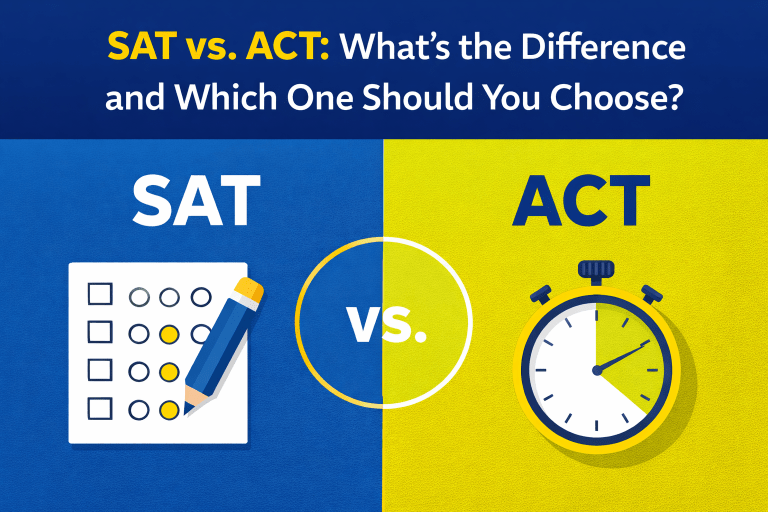
Most Indian students choose the SAT due to better test centre availability and more familiarity with the format. However, students strong in science reasoning might prefer the ACT. Check which test your target universities accept; most accept both equally.