All You Need to Know About the Latest H1B Visa Changes

“Give me your tired, your poor, your huddled masses yearning to breathe free,” articulated Emma Lazarus. These words remain a sacred mantra, engraved on the Statue of Liberty and in the hearts of all who dared to chase the “oh so beautiful, American Dream.”
For as long as travel logs date back, America has been a patchwork of diversity, further highlighted by the Latin phrase “E Pluribus Unum,” which translates to “Out of many, one.” The very quote appears on the Great Seal of the United States (1782) and symbolizes the union of diverse states into a single nation. For generations, America has been more than a piece of land; she became the allegory for freedom — to dream, to exist without shackles, without expectations. As Albert Einstein expressed so reverently, “America is a country of immigrants, and that is her strength. I came here because I believed in the freedom to think and to be.”
However, current immigration changes have been the talk of the town, particularly the H1B visa reforms.
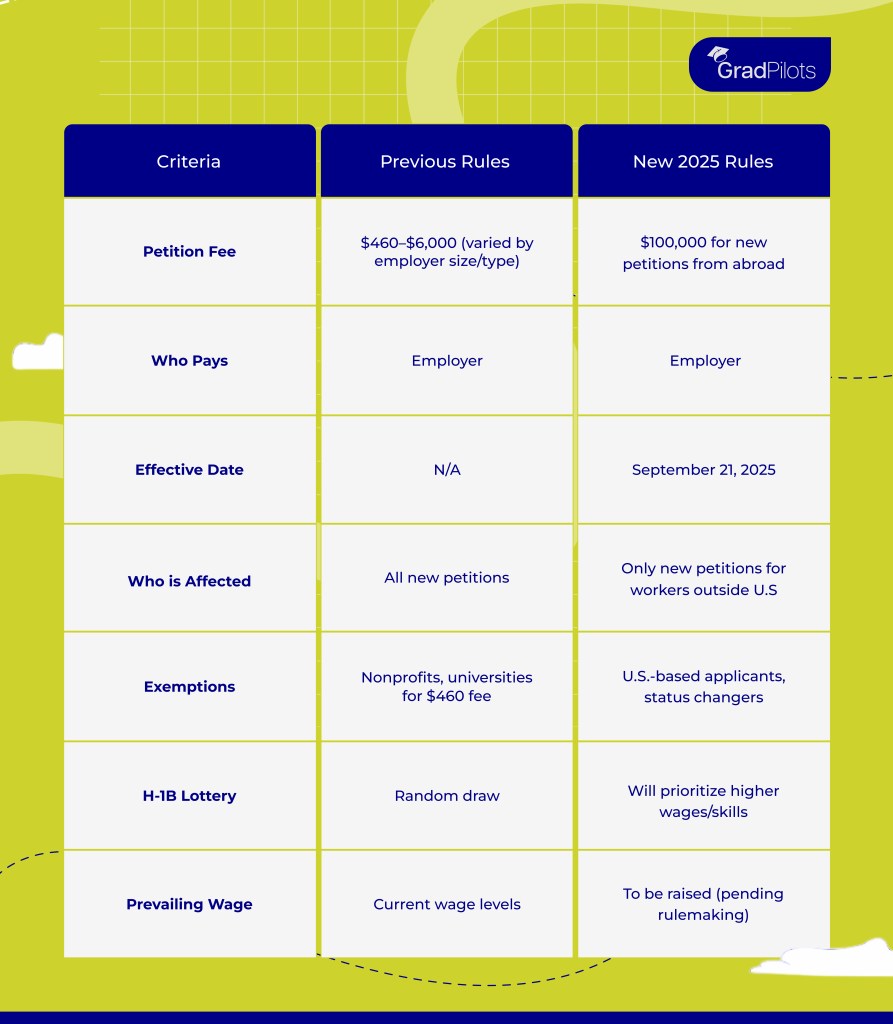
In 2025, the most notable shift is the introduction of a $100,000 fee increase for new petitions involving foreign workers outside the U.S., effective September 21, 2025. These new rules have raised the stakes for both U.S. employers who depend on international talent and Indian students and professionals who view the U.S. as a hub for career advancement. Given that over 70 percent of H1B visa holders in recent years have been Indian nationals, understanding these changes is critical for students, graduates, and early career professionals making education and migration decisions.
Drawing from The Epic of America (1931), “The American Dream is that dream of a land in which life should be better and richer and fuller for everyone, with opportunity for each according to ability or achievement.” Yet, these very changes limit opportunities for those who yearn to better their lives and bring value to a land once seen as the home of opportunity.
What is H-1B visa?
The H-1B visa is a non-immigrant visa that allows U.S. employers to hire foreign professionals in speciality occupations, typically those requiring at least a bachelor’s degree in fields such as technology, engineering, finance, health care, and academia. The H-1B is valid for up to three years, renewable for another three, and often functions as a bridge to permanent residency (a green card) for many skilled international workers, especially from India. The employer is the visa sponsor, and the visa is tied to the specific employer and job position.
Key Details of the New H1B Visa Rules
Significant reforms were announced in September 2025, reshaping the entire H-1B landscape:
Prevailing Wage and Lottery Changes: Agencies have been directed to raise prevailing wage thresholds and adjust the H-1B lottery process to prioritise higher-paid and more highly skilled applicants, encouraging employers to offer competitive salaries.
$100,000 Fee on New Petitions: For any new H-1B petitions filed on or after September 21, 2025, where the beneficiary is outside the U.S., employers must pay a $100,000 fee per worker. If this fee isn’t paid, the petition will not proceed. This fee is applicable only for 12 months (through September 20, 2026), unless extended, and does not apply retroactively or to already filed or approved petitions.
Exemptions: Applicants already inside the U.S. or those changing status, extending, or transferring H-1B employers while in the U.S. are not subject to this fee, as long as they were present by the effective date.
Restriction on Entry: The new rules predominantly apply to foreign nationals outside the U.S. at the time of petition filing. If someone travels abroad after September 21 while their petition is pending, the fee requirement could still apply.
Scope of Restriction: Applies only to new filings (not renewals or transfers) and only to beneficiaries outside the U.S..
National Interest Exemptions: The Secretary of Homeland Security can exempt certain individuals, employers, or sectors if deemed in the U.S. national interest and not a risk to the country.
Employer Compliance: Employers must submit the new fee at the time of petition, with strict rejection of applications without proof of payment.
What the New H1B Rules Mean for Indian Students?
Reduced Accessibility, Higher Costs
Indian students, who make up the largest group of H-1B beneficiaries, now face rising barriers to entering the U.S. job market after graduation. The $100,000 fee limits the willingness or ability of employers, especially smaller companies and startups, to sponsor new foreign hires directly from India. This change particularly affects those who plan to seek direct H-1B sponsorship from outside the U.S. after completing studies or employment in India.
Increased Importance of U.S. Presence
For recent graduates already in the U.S. (for example, on F-1 visas using Optional Practical Training (OPT)), these changes have less immediate effect, making it even more vital to secure a U.S. presence before petitioning for H-1B status. Students currently enrolled or graduating soon should consult closely with career and immigration advisors to avoid pitfalls related to travel and petition timing.
What should students do?
- Explore Alternatives: Consider career paths in Canada, the UK, or other countries with friendlier post-study work schemes, or look at alternatives like L-1 or O-1 visas.
- Plan Ahead: Aim to secure OPT or STEM OPT extensions, which allow up to three years of post-graduation employment authorization without the new fee.
- Stay Updated: New rules and exceptions may develop. Follow official USCIS and Department of Homeland Security updates.
- Don’t Travel Without Checking: If your H-1B petition is pending, avoid international travel after September 21, 2025, unless you understand the fee risk.
Impact on Indian Professionals and Tech Workers
While the majority of H1B recipients are Indians, IT professionals, engineers, and startup founders are the most directly affected. American employers that have been dependent on international expertise now face sharp cost hurdles when hiring Indians or any overseas candidates, often leading to a higher preference for domestic workers who do not require a 100K sponsorship. Moreover, this landmark change impacts more than employers and job seekers. For those already within the U.S., current employment-based extensions or transfers will not attract the new charge, at least for now.
With over 70 per cent of H1B visa applicants being Indian, this obstacle could lead to stagnation in the economy or even reduced economic activity, as international applicants seeking to build a future may prefer moving to the UK or Canada, countries that offer a clearer path to citizenship and freedom from the uncertainty of immigrant status.
Will the new H1B visa rules affect current visa holders?
Most current H-1B visa holders inside the U.S. are not affected by the new $100,000 fee, provided their extensions or employer change filings occur while physically inside the country as of September 21, 2025. However, those outside the U.S. wishing to return, or those with pending petitions who travel after this date, may be impacted. It’s also possible that future reforms could introduce further changes, so stay vigilant for official announcements.
Comparison — Previous vs. Current H1B Visa Policy
Why the H1B Visa Policy is Changing?
These policy shifts respond to several factors:
- Fraud and Abuse Prevention: The new rules aim to minimise perceived abuses of the H-1B system, especially by outsourcing firms or high-volume recruiters who fill lottery slots en masse.
- Labour Market Protections: To protect U.S. workers and discourage the offshoring of jobs requiring specialised skills.
- Wage Fairness: By hiking fees and raising prevailing wage requirements, the intent is to prioritise highly skilled and better-paid foreign workers, limiting lower-wage reliance on overseas talent.
H-1B Visa Alternative – Pathways and Strategies
If H-1B prospects become less accessible, consider the following options:
- OPT and STEM OPT Extension: Remain in the U.S. after graduation for up to three years, gaining both experience and new eligible filings.
- L-1 Intracompany Transfer: For executives or personnel transferring within multinational firms.
- O-1 Extraordinary ability Visa: For those with significant achievements in their field.
- Study in Canada or UK: Both destinations offer friendlier study-to-work transition programs and more direct permanent residence pathways, as shown by the 2023 CBIE survey.
- Remote and Cross-Border Work: Consider remote roles with U.S. employers while physically located in Canada or overseas (keeping visa/immigration compliance in mind).
Why Canada and the United Kingdom Are Emerging as Preferred Destinations
In recent years, Canada has positioned itself as a model of stability and transparency in international education and immigration policy. Its framework remains predictable, with minimal abrupt policy shifts, offering international students and skilled professionals a clear pathway to long-term settlement. The Post Graduate Work Permit (PGWP) and Express Entry programs exemplify this approach, allowing graduates to gain professional experience and transition to permanent residency without employer dependency. In contrast, the United States’ H1B visa system, now associated with a one-hundred-thousand-dollar fee for new overseas hires, creates structural barriers that discourage both employers and prospective applicants. Consequently, Canada’s consistent policies and merit-based evaluation processes have reinforced its global reputation as a welcoming and equitable destination for international talent.
The United Kingdom has undergone a similar transformation. The Graduate Visa enables international students to remain and work for two to three years after completing their studies, while the Skilled Worker Visa operates without an annual quota. These frameworks remove the uncertainty of lotteries, abrupt fee hikes, or politically influenced fluctuations. This predictability strengthens the UK’s position as an attractive alternative for international graduates seeking both professional advancement and long-term stability. In essence, both Canada and the UK have cultivated ecosystems that prioritise inclusivity, clarity, and mobility, qualities increasingly valued by globally mobile talent.
Why the United States Remains a Competitive Choice
Despite growing financial and procedural challenges, the United States continues to hold a distinctive position within global migration and innovation systems. Even with the recent introduction of the one hundred thousand dollar H1B petition fee, the U.S. remains unmatched in its economic potential, technological leadership, and career growth opportunities. It continues to host the world’s most advanced industries in technology, artificial intelligence, and biotechnology, as well as globally influential institutions such as Silicon Valley, leading research universities, and Fortune 500 corporations.
Furthermore, the STEM Optional Practical Training (OPT) extension grants international graduates up to three years of professional experience without requiring an H1B visa. This provides a critical adjustment period for students to navigate evolving immigration policies while contributing to the country’s research and innovation ecosystem.
However, post-2025 reforms have restructured the H1B system to prioritise higher wages, effectively favoring applicants with substantial employer backing or advanced experience. This shift renders entry-level opportunities less accessible, especially for early-career professionals. Nonetheless, for those positioned to meet these thresholds, the United States continues to represent a premier environment for intellectual growth, professional advancement, and participation in global innovation networks.
Final Recommendation
- Choose Canada if you want long-term stability, PR access, and lower risk.
- Choose the UK if you want visa certainty and a European base with moderate pay.
- Choose the USA only if you have a high-paying job offer, are in STEM, or plan to leverage OPT/STEM OPT to avoid the new fee.
The 2025 H-1B changes mark a turning point: the U.S. is no longer the default choice. Students must now strategically evaluate their goals, risk tolerance, and career stage before deciding.
Conclusion and Next Steps
The 2025 H1B rule changes mark a pivotal shift, especially for Indian students and professionals considering U.S. study and work. With sky-high fees, tighter restrictions, and evolving rules, it’s never been more important to plan ahead, stay informed, consider H1B alternatives, and consult immigration and educational experts. Smart, up-to-date strategies are more essential than ever, especially if U.S. study or work remains your dream destination.
Like Dickens wrote in A Tale of Two Cities: “It was the best of times, it was the worst of times.” The U.S. embodies both progress and crisis, both unity and fragmentation. With policy changes that have the power to dictate the fates of generations to come, fear for what could happen and hope for better seem to be in constant battle. While all eyes stay glued to what happens next, just know that there will always be options. And as selfish as it may be, choose a future that you would be proud to own, one that’s only ever guided by what’s best for you.
At GradPilots, that’s exactly what we do. We tailor-make your study abroad journey. You tell us of the future you want, and we ensure that you have all that you need to conquer it.
Frequently Asked Questions
The most significant update is a new $100,000 fee for U.S. employers sponsoring H-1B visa applicants outside the U.S., effective September 21, 2025, and planned increases in prevailing wage standards.
Current H-1B holders inside the U.S. are largely exempt from the new fee, except under specific travel or new petition scenarios.
Indian students now face greater obstacles to H-1B sponsorship from abroad and should plan to secure U.S. presence (such as OPT) before petitioning.
Highly skilled, highly paid professionals and employers filling essential, hard-to-source roles may benefit as the process aims to favour these applications.
It can still be beneficial for those able to stay in the U.S. after graduation or those eligible for exceptions or alternative visas.
As long as recent graduates and OPT/STEM OPT students remain in the U.S., they are generally not subject to the new fee for status changes, extensions, or employer transfers.