Exams for MS in USA: What Indian Students Must Know


So you’ve decided to pursue your MS in the USA. Exciting, right? But then you start googling, and suddenly you are drowning in acronyms: GRE, GMAT, TOEFL, PTE….Wait there’s more? Here’s the thing: American universities want to know two things before handing you that coveted offer letter. First, can you handle the graduate-level coursework? Second, can you actually understand what your professors are saying in English? That’s why these exams exist.
Think of aptitude tests like the GRE and GMAT as your academic report card that every university can read, no matter where you studied. They level the playing field between someone from an IIT and someone from a Tier 2 college in a small town. Language tests like TOEFL, IELTS, and Duolingo prove that you won’t sit confused in lectures or struggle to write your thesis. The good news about these exams? You don’t need to take all of them. The better news? This guide will tell you exactly which ones matter for your MS journey, how to choose between them, tips and tricks on how to ace them, and whether you can skip some altogether.
Understanding MS Admission Requirements in USA
Let’s start with the fundamentals. Before we dive into the individual exams, let’s zoom out and look at the bigger picture. The American graduate admissions system runs on standardised tests. These tests create a common measuring scale. Your GRE score of 325 would mean the same thing whether you studied in Bangalore or Beijing. Similarly, a TOEFL score of 110 tells Harvard that you have the same English proficiency as someone who scored 110 at any test centre worldwide. The testing landscape, however, has evolved significantly in recent years. Pre-2020, almost every MS program required GRE scores and English proficiency tests. Post-COVID, there’s been a shift towards test-optional policies, especially for students with strong academic backgrounds or relevant work experience. However, competitive programs at top-tier universities still expect these scores, and most scholarship committees use them as filtering criteria.
That said, these exams are just one piece of your application puzzle. Understanding the eligibility for MS in the USA means looking at your entire profile: GPA, Statement of Purpose, Letters of Recommendation, research experience, and work experience all carry weight. Strong test scores won’t compensate for a weak academic record, and occasionally, exceptional research experience can offset slightly lower test scores. But for most applicants, solid standardised test scores open doors.
List of exams required for MS in the USA
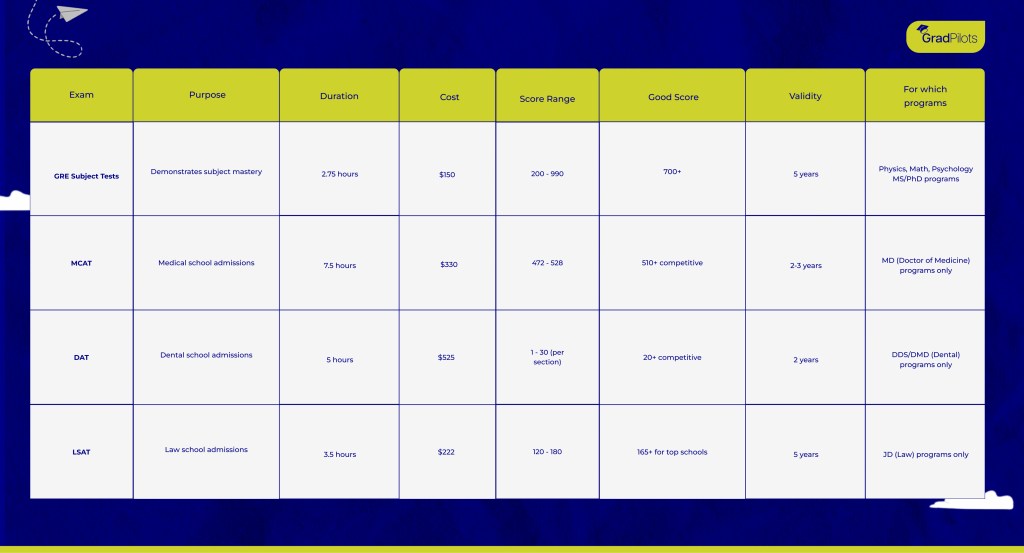
The exams for MS in the USA fall into three main categories: (1) General Graduate Admission Tests, (2) English Proficiency Tests, and (3) Subject-Specific Exams. The tables below show everything you might encounter – but don’t panic, most students only need two exams total.


So which ones do you actually need? If you belong to the majority of Indian students applying for MS in fields such as Computer Science, Engineering, Economics, Data Science, or related fields, your combination is simple: GRE + TOEFL (or IELTS or Duolingo). That would be the standard package for eligibility for MS in the USA.
If you are targeting an MBA or a specialised business master’s, you can swap GRE for GMAT. GMAT is the standard for MBAs, but the GRE is gaining traction from a lot of top universities as an acceptable alternative. Already have a strong GATE score? Some universities, like the University of Florida and Missouri S&T accept GATE instead of GRE for engineering programs. Definitely worth checking if you want to spare your wallet the burden of the GRE fee. For English tests, TOEFL is still the default choice most US universities prefer, but IELTS works fine, and Duolingo is catching up fast because it’s cheaper and you can take it from home.
Now about those subject-specific exams: unless you’re applying to medical school (MD programs, which need MCAT), dental school (DAT), or law school (LSAT), ignore them completely. They’re for professional degrees, not MS programs. Even if you’re doing MS in Biology or Public Health, you take the GRE, not MCAT. GRE Subject Tests (Physics, Math, Psychology) are a different story – some competitive MS or PhD programs recommend them to show deeper subject knowledge, but the majority of the MS programs don’t require them.
Requirements for MS in USA for Indian Students
Test scores are just one piece of the puzzle. The eligibility for MS in USA for Indian students involves several other components that Admission Committees (AdComs) evaluate together.
Academic Profile
Your undergraduate GPA carries significant weight. Most competitive programs expect a 3.0+ on the US 4.0 scale, which roughly translates to 60-65% or 7.0+ CGPA depending on your university’s grading system. Top-tier programs like MIT, Stanford, Carnegie Mellon, and NYU, typically look for 3.5+ (75% or 8.5+ CGPA).
Your transcripts need to reflect the courses you are targeting through relevant coursework. Applying for MS in Data Science? AdComs want to see statistics, programming, and mathematics courses. MS in Mechanical Engineering? Thermodynamics, fluid mechanics, design, and manufacturing courses matter. Don’t be afraid to switch fields though. Even if you don’t have the coursework, you can demonstrate foundational knowledge through projects, certifications, work experience, or a personal portfolio.
SOP, LORs, and Resume
Your Statement of Purpose (500-1000 words) needs to answer three questions: Why this program? Why this university? Why you? Remember to focus on specifics rather than generic narratives. Try to include personal anecdotes, professors you would like to work with, subjects you are looking forward to studying, and your future career goals. Letters of Recommendation (2-3 required) should come from people who actually know you and can speak about your work. A professor who taught you in multiple courses and supervised your final year project is more valuable than a department head who barely remembers your name. For students with work experience, one of these LORs can come from a manager or a senior colleague.
Your resume (1-2 pages maximum) should highlight academic projects, internships, research experience, publications if any, and relevant technical skills. If you’ve contributed to open-source projects, built something noteworthy, or have strong GitHub repositories, include them (in your resume and your SOP if relevant). For Computer Science aspirants, eligibility often gets a boost from demonstrated coding skills beyond coursework.
Work Experience
Unlike MBA programs, most MS programs don’t require work experience. However, 1-2 years of relevant industry experience can strengthen your application, especially for specialised programs like Data Science or Cybersecurity, where practical exposure adds value. If you’re applying straight after your bachelor’s, strong projects and internships can compensate well.
Financial Documents
This is not an important part of your application, but you’ll need it for the I-20 visa document after admission. However, some universities do ask for financial documents upfront, so make sure you check individual requirements. You’ll need to prove you can afford tuition and living expenses, roughly $50-80k per year, depending on the university and location. This includes bank statements, scholarship letters, or loan sanction letters.
MS in USA Without Exams: Is It Possible?
The test-optional trend has grown significantly since 2020, with more universities offering pathways for students with strong academic profiles to skip standardised tests. However, these alternatives come with important caveats worth understanding before you decide to forgo exams entirely. Several universities now waive GRE requirements for applicants meeting specific criteria. NYU Tandon School of Engineering, Stevens Institute of Technology, and some programs at Arizona State University have made GRE optional for MS programs. George Mason University, the University of Dayton, and Worcester Polytechnic Institute offer waivers on a case-by-case basis, typically for students with GPAs above 3.5 or several years of professional experience.
English proficiency waivers follow a different logic. Rather than being test-optional, they’re granted when you’ve already proven English competency through your educational background. Policies vary – some universities require three years of English-medium education, others require four, and some only waive for students from specific countries.
Beyond waivers, universities may accept different proof of capability. Published research papers, a strong professional portfolio (particularly for design, architecture, or software engineering programs), or patents and technical contributions can demonstrate your readiness for graduate study. Some programs value industry certifications in lieu of standardized tests, though this is less common. MOOCs and online certifications from platforms like Coursera or edX generally don’t replace standardized tests, but they can strengthen applications when used to fill knowledge gaps for career switchers.
The biggest risk is reduced options. Test-optional doesn’t mean test-blind. Competitive applicants at these universities often still submit strong scores, making your application comparatively weaker without them. Top-tier programs rarely waive requirements for MS admissions. Scholarship opportunities narrow significantly. Many merit-based scholarships, teaching assistantships, and research assistantships use GRE scores as initial filters. Without test scores, you’re competing for a smaller funding pool, often limited to need-based aid or employer sponsorships. If your profile is exceptionally strong with publications, prestigious internships, or notable professional achievements, test waivers make sense. For most applicants, taking the exams keeps more doors open.
How to Choose the Right Exam for Your MS in the USA?
Choosing the right combination of exams depends on several factors working together. Start with your target programs’ requirements. Check the admissions pages of 5-6 universities you’re seriously considering – what do they require, what do they prefer, and what do they accept as alternatives? Some business schools accept both GRE and GMAT but prefer GMAT scores. Don’t choose an exam before confirming your target schools actually accept it.
Next, assess your strengths honestly. Strong in mathematics and analytical reasoning? The GRE’s quantitative section is straightforward for most Indian STEM students. Comfortable with business-oriented problem-solving and data interpretation? GMAT might suit you better. For English tests, consider your comfort level – do you prefer typing essays and speaking to a computer (TOEFL, PTE, Duolingo), or does a face-to-face conversation feel more natural (IELTS)? Test format matters more than you’d think. Some students perform better on adaptive tests where difficulty adjusts to your responses (GRE, Duolingo), while others prefer fixed-format exams (IELTS). Take diagnostic tests for your shortlisted options before committing to one – most testing services offer free or low-cost practice tests that simulate the actual experience.
Plan your exam budget realistically. Between test registration fees, preparation materials, and score reporting to multiple universities, expect to spend ₹40,000-₹60,000 total. If the budget is tight, Duolingo ($59) costs significantly less than TOEFL or IELTS (₹16,000+), though you should verify your target universities accept it first.
Work backwards from your application deadlines when planning your timeline. Applying for Fall 2026 intake with December 2025 deadlines? Start GRE preparation by June 2025 to give yourself 4-5 months. Schedule your GRE for August-September, leaving buffer time for retakes if needed. Take your English proficiency test a month or two before you plan to submit your applications – these require less preparation time if your English is reasonably strong.
Stagger your exams rather than cramming both in the same month. Preparing for GRE while simultaneously studying for TOEFL splits your focus and often leads to mediocre scores on both. Finish one exam, then move to the next. Build retakes into your timeline from the start. You can retake the GRE every 21 days, up to five times per year. TOEFL allows retakes every three days with no annual limit, though at ₹16,900 per attempt, costs add up quickly. IELTS has no waiting period, but it is equally expensive.
Only retake if you’re confident of a significant improvement – aim for at least a 5-point increase on GRE or 5-10 points on TOEFL. A marginal 2-3 point improvement rarely changes admission outcomes and wastes time and money better spent on strengthening other application components.
How GradPilots Can Help Your Master’s Journey?
Navigating the exams for MS in the USA is just the beginning. Between choosing the right universities, crafting compelling application materials, meeting eligibility for MS in USA requirements, and securing funding, the MS application process has dozens of moving parts where guidance makes a real difference. GradPilots offers personalised support across your entire application journey. We help you identify which exams your target programs require, create realistic application timelines, and strategise around test-optional pathways if they make sense for your situation. Want to understand exam-taking strategies or get general insights? Connect with peers in our network who’ve already been through the process or chat with mentors who can share their experiences.
Beyond exams, we guide you through university shortlisting, SOP and LOR development, scholarship applications, and visa processing. Whether you’re exploring MS in Computer Science in the USA for Indian students’ eligibility or researching business programs, GradPilots provides the specific, actionable guidance that gets you from “thinking about MS” to “accepted with funding.”
Frequently Asked Questions
Depends on your program and university. Many top programs (especially in CS, Engineering, and Data Science) still prefer or require GRE scores. However, the test-optional trend is growing. Universities like NYU Tandon, Stevens Institute, and some Arizona State programs have waived the GRE. Check specific program requirements on university websites. In either case, a good GRE score could be a good way to give yourself an edge.
It varies by individual strengths. Duolingo is the shortest (1 hour) and cheapest ($59), which makes it very convenient. However, it’s still not recognised by a lot of universities. IELTS has face-to-face speaking, which some find easier than speaking to a computer (TOEFL/PTE). PTE’s AI scoring can be advantageous with practice. It’s recommended to try a diagnostic test for each to see which format suits you best.
Yes, but with limitations. Some universities offer GRE waivers for strong academic profiles. English test waivers are possible if you completed your bachelor’s degree in English medium. However, exam-waiver options reduce your university choices and scholarship opportunities. Most competitive programs still expect standardised test scores. If you believe that you have a competitive profile without these scores and your target university does not list them as compulsory, you can forgo them.
Top universities (MIT, Stanford, Carnegie Mellon, UC Berkeley, Columbia) typically expect 320+ overall, with 165+ in Quantitative for STEM programs. For top business/social science programs, balanced scores (160+ in both sections) matter more. However, GRE is just one factor. Strong GPA, research experience, leadership positions, and recommendations can compensate for slightly lower scores.
The earlier the better. Ideally, 6-8 months before application deadlines. Start with aptitude tests (GRE/GMAT) as they need 3-4 months prep, then take English tests 2-3 months before applying. This gives you buffer time for retakes if needed. For the Fall 2026 intake (applications due Dec 2025), start preparing by April-May 2025.