
How to Get Into Ivy League Colleges: Your Proven Step-by-Step Guide


There are moments in life when a dream feels larger than ourselves, and for many students, the dream of an Ivy League education carries that kind of weight. To walk the same hallways as Nobel laureates, Supreme Court justices, and Fortune 500 CEOs is not just about prestige, it is about belonging to a tradition that has shaped generations of thinkers and leaders.
But getting into the Ivy League is no ordinary task. It is a journey that demands excellence, but also honesty, resilience, and the courage to present your most authentic self. As Viktor Frankl once said, “Those who have a why to live, can bear with almost any how.” The Ivy League admission process is less about chasing perfection and more about uncovering your deepest why.
Before we dive into the steps, let us first look at the Ivy League itself.
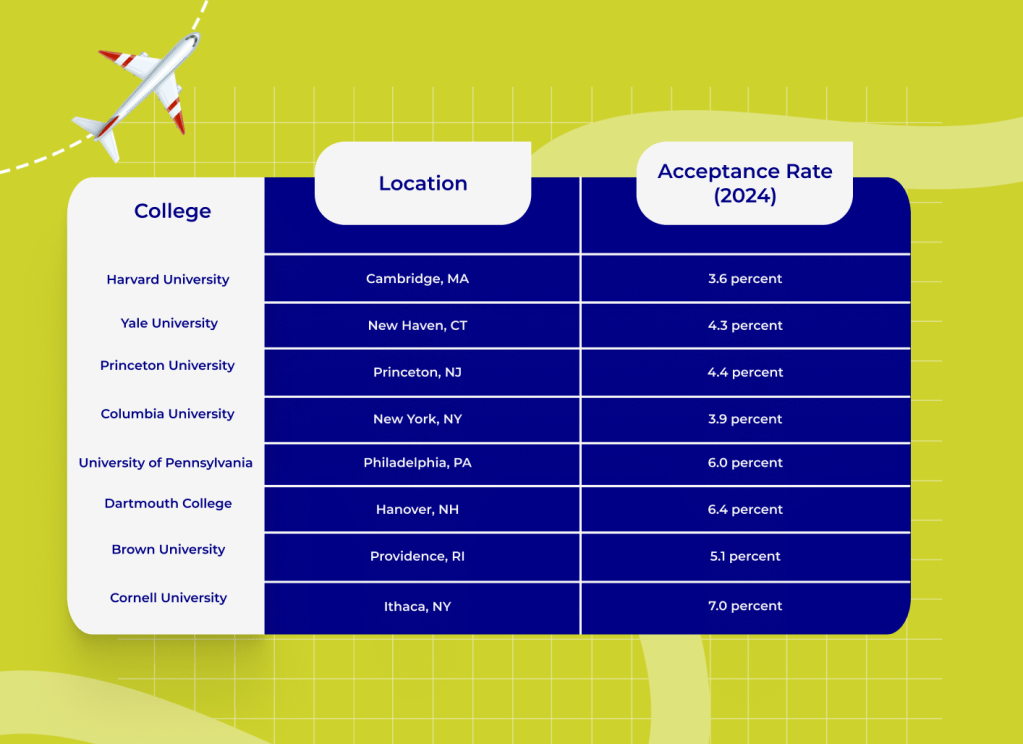
The Ivy League is made up of eight incredibly prestigious colleges in the US, each known for academic excellence, amazing alumni networks, and super competitive admissions. There is Harvard in Cambridge, Massachusetts, Yale in New Haven, Connecticut, Princeton in New Jersey, Columbia in New York City, University of Pennsylvania in Philadelphia, Brown in Providence, Rhode Island, Dartmouth in Hanover, New Hampshire, and Cornell in Ithaca, New York. Each campus has its own vibe, and part of what makes applying so exciting is figuring out which one feels like the right fit for you.
Getting in is not easy these schools are insanely selective. Harvard sits at around a 3 to 4 percent acceptance rate, while Princeton and Columbia are a bit higher at 4 to 5 percent. Yale and UPenn are also around 4 to 5 percent, with Brown and Dartmouth closer to 5 to 6 percent. Cornell, being the biggest Ivy, is slightly more lenient at 8 to 10 percent, but it is still super competitive. Honestly, these numbers just show how much effort and planning you need if you are aiming for the Ivy League.
Where each school is located also makes a big difference in your experience. Columbia and UPenn are in big cities, which means tons of opportunities for internships, networking, and city life. On the other hand, places like Princeton, Dartmouth, and Brown are in smaller towns, giving you that close knit campus feel where everyone knows each other and life is really focused on campus. When thinking about where to apply, it is not just about prestige it is about what kind of environment you want to be in for the next few years
Ivy League requirements
Ivy League requirements are not written in stone but are understood through patterns of admitted students. Strong academics, top standardized test scores, exceptional extracurriculars, glowing recommendations, and essays that tell a deeply human story all matter. But more than anything, admissions officers look for authenticity and potential impact.
Psychological research on selection bias suggests that humans are drawn to narratives that feel consistent and coherent. This is true for Ivy League applications as well: it is not about doing everything, it is about doing the right things well, with purpose.
What does the Ivy League admission process look?
Research Ivy League Schools
Each Ivy League college has its own heartbeat. Columbia thrives in the rhythm of New York City, while Dartmouth flourishes in close knit intimacy. Harvard leans on tradition, while Brown celebrates freedom.
Your task is not to ask, “How do I get into the Ivy League?” but rather, “Which Ivy League belongs to me?”
Resources for this search include official websites, campus tours, and conversations with alumni. Remember the words of Socrates: “Know thyself.” This is the first step toward knowing where you belong.
Excel Academically
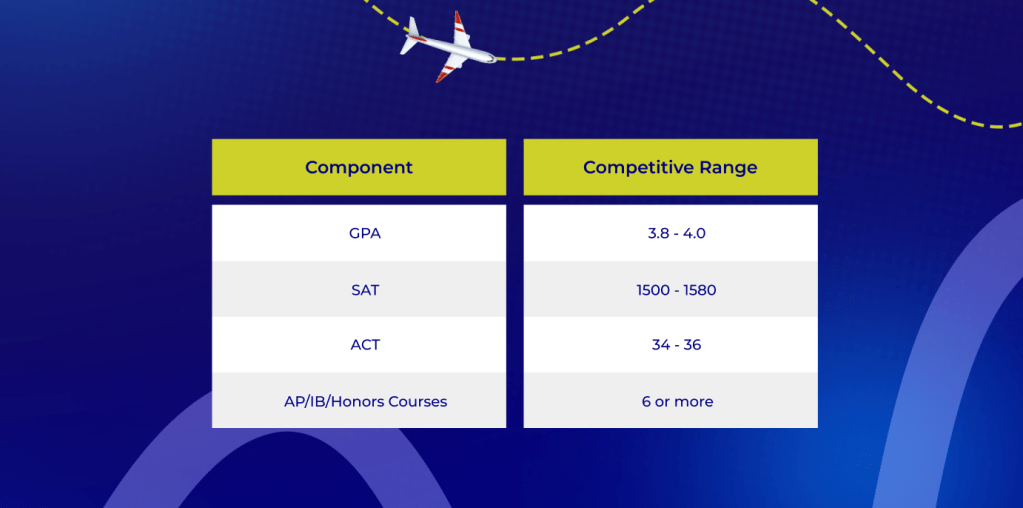
Grades are the foundation. Competitive applicants generally present GPAs close to 4.0 and take the hardest courses available, whether Advanced Placement, International Baccalaureate, or honors classes.
But grades are not just numbers. They are signals of discipline, perseverance, and intellectual hunger. A study in educational psychology by Angela Duckworth highlighted “grit” as the strongest predictor of success, often even more important than IQ. Your transcript is less about the score and more about the story of your grit.
Aim for Top Standardised Test Scores
While some schools are test optional, standardized tests still matter greatly for Ivy League admissions. They level the playing field, offering a universal measure across diverse education systems. A 1550 SAT or 35 ACT is often considered a competitive benchmark.
The key is not just content mastery but psychological readiness. Cognitive load theory reminds us that stress impairs working memory, so practice under timed conditions is vital to replicate the test environment
Develop Extracurricular Profile
The Ivy League looks for leaders, creators, and changemakers. Do not try to be everything at once. Instead, develop a “spike” , one or two activities where you stand out significantly.
Admissions officers are guided by social science research that values “authentic passion” over “resumé padding”. Whether you are publishing research, founding a nonprofit, excelling in sports, or creating art, what matters is depth, not breadth.
Craft Compelling Essays
Writing college essays can feel intimidating, but they are one of the best ways to show who you are beyond grades and test scores. Focus on being authentic and sharing what excites you about a school or program instead of trying to impress. For the Common Application, choose a topic that reflects your growth, perspective, or character and tell your story in a clear and thoughtful way. Your resume and activities section should highlight experiences that show commitment, leadership, and impact. Quality always matters more than quantity, so focus on what really defines you. Start early, revise carefully, and get feedback from people who know you well. This is your chance to tell your story in your own voice and make it memorable.
Demonstrate Interest
Admissions officers want to know you care. Attend virtual sessions, email professors, and visit campuses if possible. Engagement matters. Demonstrated interest is not about flattery but about signalling genuine fit.
Prepare for Interviews
Admissions officers want to know you care. Attend virtual sessions, email professors, visit campuses if possible. Engagement matters. Demonstrated interest is not about flattery but about signaling genuine fit.
What to Do After Applying?
Waiting is difficult. Some applicants will face waitlists or deferrals. Research in behavioural science shows that uncertainty creates more stress than negative outcomes. To cope, focus on what you can control: new opportunities, backup schools, and continued growth. Patience is part of this journey. As Rumi said, “Try to accept the changing seasons of your heart, even if you have not yet understood their purpose.”

Conclusion
The Ivy League dream is not about chasing perfection but about becoming deeply yourself. It is about pursuing truth in your essays, discipline in your academics, and courage in your interviews.
If you walk away with one thought, let it be this: Ivy League admissions do not ask, “Are you flawless?” They ask, “Are you ready to grow?”
And if you are, then the doors you seek may open in ways you never imagined.
Ready to Launch Your Global Education Journey? Let GradPilots guide you to the perfect course, country, and university.
Start with GradPilots Today.
Frequently Asked Questions
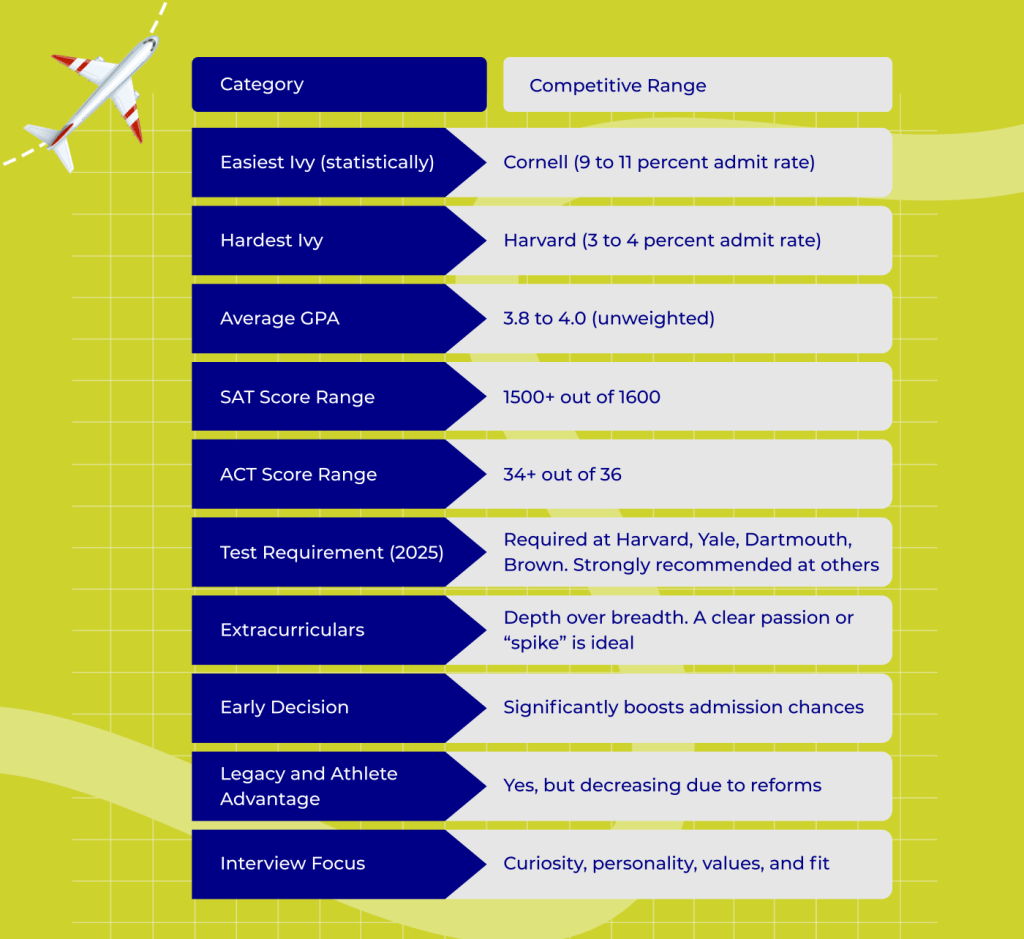
Statistically, Cornell University has the highest acceptance rate among the Ivy League schools, usually around 9 to 11 percent. But “easier” is relative. Every Ivy League school is highly selective. The better question is: Which Ivy League aligns with my strengths, values, and aspirations?
Most admitted students have a 3.8 to 4.0 unweighted GPA. A slightly lower GPA does not automatically disqualify you, especially if your grades show growth or you pursued challenging courses. Admissions officers value resilience and upward progress as much as consistent perfection.
Harvard University is typically the hardest, with an acceptance rate of around 3 to 4 percent. Still, difficulty is relative. Success depends on your unique strengths and how well you align with the school’s values.
A SAT score above 1500 or an ACT score above 34 makes you competitive. However, admissions are holistic. Strong essays, leadership, and achievements can balance slightly lower test scores.
As of 2025, Harvard, Yale, Dartmouth, and Brown require SAT or ACT scores, while others strongly recommend them. Policies change often, so check each school’s website before applying.
Extracurriculars are crucial, but depth matters more than quantity. A focused passion or standout achievement is more powerful than a long list of shallow commitments. Admissions officers call this having a “spike” — a clear talent or passion that sets you apart.
Yes, though these policies face increasing scrutiny. Legacy applicants and recruited athletes often have advantages, but authenticity, intellectual curiosity, and impact still carry weight for everyone else.
Yes. Applying Early Decision or Restrictive Early Action often increases your chances. For example, Harvard’s early admit rate has been three to four times higher than its regular decision rate. If you are confident in your first-choice school, applying early is strategic.
Do not give up. Many successful Ivy League admits had lower-than-average numbers but made up for it with powerful essays, impactful projects, or leadership. Admissions officers look for potential and passion, not just perfection.
Interviews are conversational and usually conducted by alumni. They focus on your personality, intellectual curiosity, and life experiences. Expect questions about books you have read, challenges you have faced, or your perspectives on global issues.