What is Duolingo English Test? Everything You Need to Know


You probably know Duolingo as that slightly passive-aggressive green owl who guilt-trips you into practising Spanish at 11 PM. That same owl is now sitting on the admissions desks of over 5,000 universities worldwide, including Ivy League schools, MIT, Stanford, and leading institutions across the UK, Canada, and Australia.
The Duolingo English Test (DET) has gone from an “interesting alternative” to a genuinely mainstream English proficiency exam, and it has made this journey fast. Over 97% of the top 100 US News-ranked universities now accept it. India is one of Duolingo’s largest global markets, with the test being taken across more than 750 cities. Makes one wonder what’s actually driving the switch? At $70, it costs a fraction of IELTS or TOEFL. You take it from home, get your results in 48 hours, and can send scores to unlimited universities at no extra cost. For students juggling application deadlines, college shortlists, tight budgets, and other standardised exams like the GRE or the GMAT, that’s a meaningful difference.
So, what is Duolingo English Test? This blog goes over how the test works, what the format looks like, how scores are calculated, which universities accept it, and most importantly, whether it’s the right test for you.
Understanding the Duolingo English Test – The Basics
The Duolingo English Test is an online, computer-adaptive English proficiency exam developed and administered by Duolingo. Yes, the same company behind the language-learning app. Launched in 2016 and accepted by over 5,000 universities in more than 100 countries, the DET is designed to assess how well you can read, write, listen, and speak in English. For most international students, it serves as proof of English proficiency for university admissions — the same function as IELTS or TOEFL, but delivered entirely online.
The test is computer-adaptive, which means the difficulty of questions adjusts in real time based on your responses. You take it from home, at any time, and get your results within 48 hours.
Why is DET Becoming Popular Among International Students?
The DET existed before COVID-19, but the pandemic was the turning point for its popularity. When testing centres shut down globally in 2020, universities needed an alternative fast, and the DET was the only major English proficiency test already built for at-home delivery. According to Duolingo’s own data, the company saw 700% growth in tests taken globally in the months following centre closures. More importantly, 99% of the programs that started accepting the DET before January 2021 continue to accept it today, long after in-person testing resumed. The situation that brought on its popularity passed, but the convenience stuck.
For Indian students specifically, this shift has been significant. India is now one of Duolingo’s largest global markets, with the test being taken across more than 750 cities. The appeal is practical: no test centre visits, no rigid exam date to book weeks in advance, and results fast enough to meet tight application windows. For students in smaller cities or towns where IELTS and TOEFL centres are less accessible, the DET removes a real logistical barrier. It’s also worth noting that when Duolingo surveyed students who had taken more than one English proficiency exam, the majority said they would choose the DET if all tests were universally accepted. That’s not just a convenience preference. It reflects a genuine shift in how students want to be tested.
How does Duolingo test Differ from IELTS and TOEFL?
The three tests measure the same thing, “English proficiency”. However, the experience of taking them is quite different. Here’s a quick comparison:

One thing worth noting is that IELTS Academic still has a separate in-person speaking component administered by a human examiner, which some universities prefer for higher-level programs. A small number of institutions, including Oxford, do not currently accept the DET, so always verify with your specific programs before deciding.
Duolingo English Test Format and Structure
The DET is structured around three sequential parts, and the whole test-taking experience would be ~60 minutes long. Before diving into questions, you go through a 5-minute onboarding where you verify your ID, check your camera and microphone, and review the rules. After that, the actual test begins.
Test Sections and Question Types
The bulk of the test is a 45-minute adaptive section, where question difficulty adjusts in real time based on how you’re performing. Answer correctly, and the next question gets harder. Answer incorrectly, and the difficulty level drops a notch. This is exactly why the DET can assess your proficiency accurately in under an hour. Rather than putting everyone through the same fixed set of questions, it calibrates to your level as you go.
The adaptive section covers all four skills: reading, writing, listening, and speaking. All of them are tested through a range of question types. As of the July 2025 update, the current question types include:
Reading and Vocabulary:

Read and Select (identify real English words), Fill in the Blanks (complete sentences with missing words), Read and Complete (fill in missing letters within a passage), and Interactive Reading (a set of passage-based tasks including Complete the Sentence, Complete the Passage, Highlight the Answer, Identify the Idea, and Title the Passage).
Listening: Listen and Type (transcribe spoken statements), and Interactive Listening (a two-part simulated conversation where you complete fill-in-the-blank sentences, respond to multiple-choice questions, and write a short summary of the dialogue).
Speaking: Speak About the Photo (describe an image for up to 90 seconds), Read, Then Speak (read a prompt and respond verbally), and Interactive Speaking (a series of 6–8 conversational questions with 35 seconds to respond to each, introduced in July 2025).
Writing: Write About the Photo (written description of an image), and Interactive Writing (read a passage, write a response, then write a follow-up).
Two question types (Read Aloud and Listen, Then Speak) were removed in July 2025 to keep the test within the one-hour window.
The final 10 minutes of the test are the Writing Sample and Speaking Sample. These are open-ended prompts where you write and speak at length on a given topic. Importantly, these two sections are unscored. They don’t factor into your overall DET result. However, your responses are shared with universities on request, so admissions teams may review them as part of your application.
Test Duration and Timing
The total test time is approximately 60 minutes, broken down as follows:

The test offers a lot of flexibility for the student because once you purchase the test, you have a 21-day window to take it. You can schedule it whenever it works for you within that period. There are no fixed slots, and no advance booking is required.
Duolingo Test Scoring System: What Your Score Means
Your DET score report contains more than just one number. Once your results come in, you’ll see an overall score, 8 subscores, and a CEFR (Common European Framework of Reference for Languages) level. Knowing how to read all of this can help you pick the right programs to apply to and figure out where to focus if you need to retake.
Score Range and Sub scores
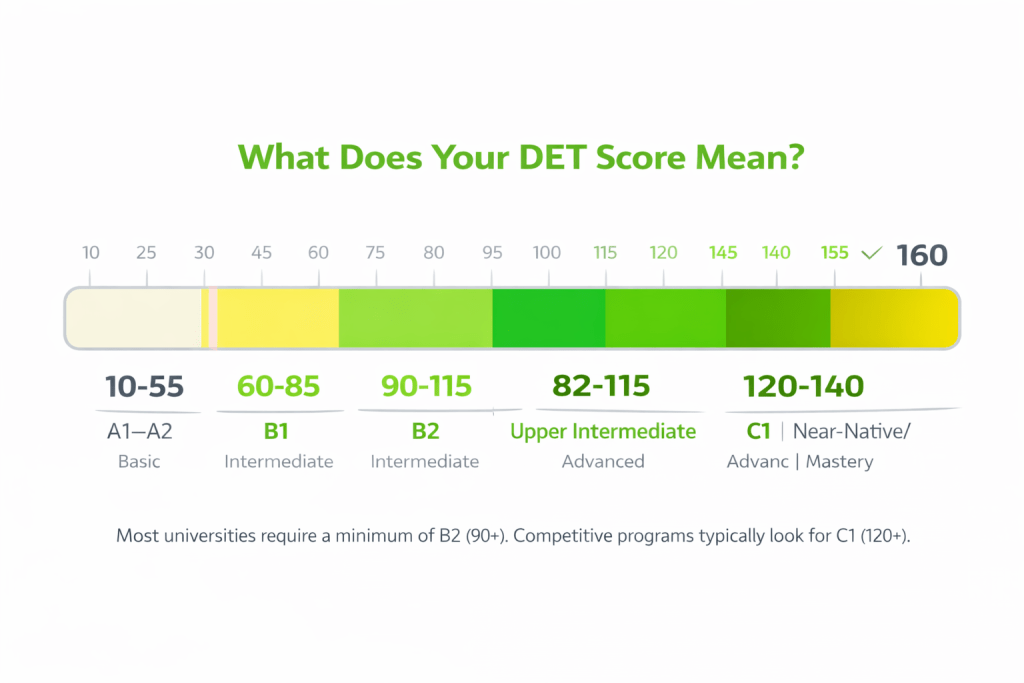
DET scores run on a scale of 10 to 160, reported in 5-point increments. Your overall score maps to a CEFR level, which is the international benchmark that universities use to compare English ability across different tests. Here’s how the ranges break down:
Since July 2024, your score report shows 8 subscores in total: 4 individual and 4 integrated. The individual subscores cover Reading, Writing, Listening, and Speaking separately. The integrated subscores combine pairs of skills:
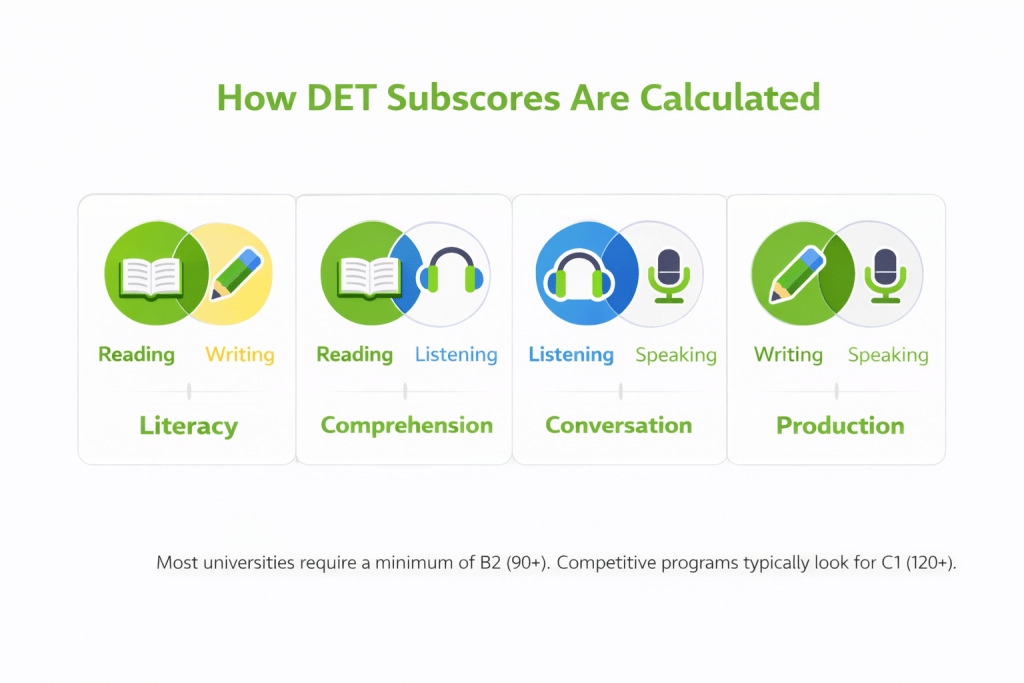
The reason Duolingo reports integrated subscores is practical. In a university classroom, you’re rarely using one skill in isolation. You listen to a lecture and take notes, you read a paper and then discuss it in a seminar. The integrated scores give admissions teams a more accurate read of how a student will actually function academically. A growing number of graduate programs are now setting minimum thresholds on specific subscores, particularly Production and Conversation, on top of the overall score requirement. So if you’re targeting a competitive program, check whether they specify subscore minimums, not just the overall cut-off.
What Score Do You Need for University Admission?
There’s no universal passing score on the DET. Each institution sets its own minimum, and requirements vary by program level, field of study, and country. That being said, a score of 120 is the widely-cited benchmark for competitive admissions. It corresponds to C1 proficiency and is roughly equivalent to an IELTS 7.0 or a TOEFL iBT score of around 94–101. Programs in medicine, law, and research-intensive fields tend to sit at the higher end. Always check your target university’s admissions page directly, since these are general patterns, not guaranteed cut-offs.
How Long Are DET Scores Valid?
Your certified DET score is valid for two years from the test date. Within that window, you can send your results to unlimited universities at no extra cost, directly from your Duolingo account. For context, TOEFL charges around $29 per additional score report after the first four, and IELTS charges similarly per extra send. If you’re applying to eight or ten universities, which many international students tend to do, the savings add up quickly.
One thing to keep in mind: you have control over which test attempts get certified and shared. If you take the test and aren’t happy with your score, you can choose not to certify that attempt.
Duolingo Test Cost
The DET costs US$70 USD for a single test. If you’re planning to take it more than once, Duolingo offers a two-test bundle for US$118, which works out to US$59 per test. The fee is the same regardless of which country you’re in, though you may see slight variation due to regional taxes or currency conversion. If you need your results faster than the standard 48-hour window, a 12-hour priority results option is available for an additional US$39.
For Indian students, the standard fee translates to approximately INR 6,200 at current exchange rates, compared to roughly INR 17,000 for IELTS or TOEFL. Once you purchase the test, you have 21 days to take it and can retake it up to twice within any 30-day period.
How to Prepare for the Duolingo English Test
Because the DET is adaptive, you can’t really game it with question-specific tricks the way you might for a fixed ability test. The questions adjust to your level in real time, so preparation that improves your actual English ability tends to work better than rote memorisation of question formats.
That being said, getting familiar with the question types before test day genuinely helps, not because you’ll memorise answers, but because you’ll know what’s expected and won’t lose time figuring out instructions mid-test. Here’s a practical approach that has been curated by talking to students who have given the test in the past few months:
Start with the official resources. Duolingo’s own Test Readiness page has a free official practice test, a downloadable test handbook, video walkthroughs, and examples of every question type. The handbook has a section on preparing your test environment and test security. This is worth reading carefully, since technical issues or flagged behaviour during the test can delay or invalidate your certification.
Take at least one full-length mock test. A 45-minute adaptive section requires sustained focus, and the pacing feels different from regular study. Sitting through a full mock test helps you understand how your energy and concentration hold up across the whole session, particularly for the speaking and writing sections toward the end.
Focus your prep on your weakest subscores. Once you have a practice score, look at which of the four integrated subscores is pulling your overall score down. Production (Writing + Speaking) is the most common weak spot for students who are stronger readers than speakers. Targeted practice here tends to move your overall score more than spreading time evenly across all sections.
For speaking specifically: practise out loud, not just in your head. The Interactive Speaking and Speak About the Photo sections give you limited response time, and students who haven’t practised speaking to a microphone often underperform relative to their actual level. Two things that help: (1) record yourself responding to practice prompts and listen back to catch filler words, unclear pronunciation, or disorganised responses, (2) rope in a friend or study partner for regular conversation practice. Speaking with someone you’re comfortable with helps you build fluency and get used to structuring responses on the spot, which is exactly what the Interactive Speaking section tests.
Use the two-test bundle strategically. If your application deadlines give you room to take the test twice, buy the bundle upfront. Not only is it cheaper per test but having a second attempt in reserve takes some pressure off the first sitting as well.
Universities That Accept Duolingo English Test
Over 5,000 universities across 100+ countries now accept the Duolingo English Test, a number that has grown from under 200 institutions in 2019. For most international students, the question is no longer “does anyone accept this?” but rather “does my specific program accept it?” That distinction matters because acceptance can vary within the same university across departments, degree levels, intake year, and program types.
Top Universities Accepting Duolingo test Worldwide
The US has the broadest acceptance by far, with over 3,100 institutions on the list, including 95% of the US News Top 100. Every Ivy League school accepts the DET, and so do MIT, Stanford, University of Chicago, Northwestern, and Johns Hopkins. Over 75% of US graduate programs with high international student enrollment also accept it.
In Canada, over 400 universities and colleges accept the DET, including the University of Toronto, McGill, the University of British Columbia, and McMaster. Importantly, Canada’s immigration authority (IRCC) also recognises DET scores for study permits, which means you don’t need a separate in-person test for your visa application. This became even more relevant after Canada discontinued the Student Direct Stream (SDS) in November 2024, which previously required an in-person English test.
The UK picture is more nuanced. Over 130 universities accept the DET for admissions, including several Russell Group institutions – University of Warwick, University of Liverpool, University of York, University of Southampton, King’s College London, and UCL, among others. However, the UK student visa requires a SELT (Secure English Language Test), and the DET does not currently qualify as one. If you’re applying to UK universities, you may need to check whether your program requires a separate IELTS UKVI or PTE UKVI score for visa purposes, even if your university accepts DET for admissions.
In Australia, 90+ universities accept the DET for both undergraduate and postgraduate programs, including Group of Eight institutions such as the Australian National University and Monash University. The DET is also accepted for the Australian student visa (Subclass 500), though individual programs may still specify IELTS.

Duolingo Test Acceptance in Popular Countries for Indian Students
India is the largest single market for DET globally, with the test taken across more than 750 cities. Here’s a country-by-country snapshot of what Indian students need to know:
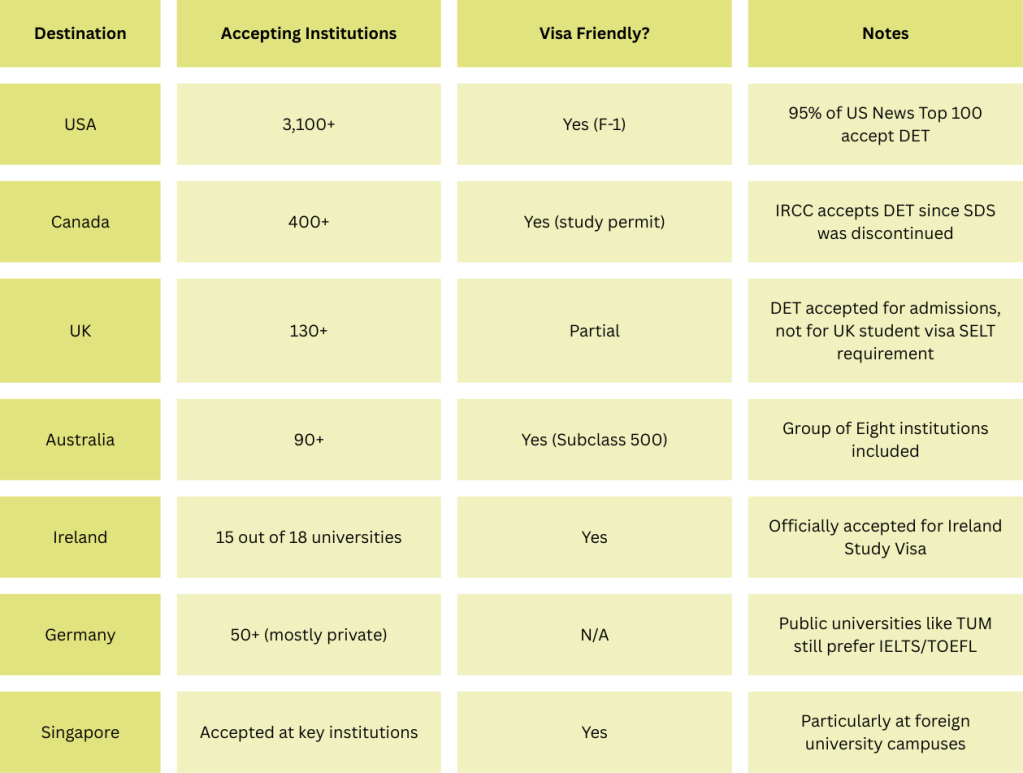
The UK visa caveat is the most important one for Indian students to keep in mind. If the UK is on your shortlist, verify both the admissions requirements and the visa requirements separately before deciding which test to take.
How to Check If Your University Accepts Duolingo Test
The most reliable way is to use Duolingo’s official institution search tool. You can filter by country, institution name, and program type to see whether your target university is listed and what score they require. That said, the tool doesn’t always reflect the most recent changes. Acceptance lists update regularly, and some departments update their requirements faster than the central database does. So, after checking the DET tool, go directly to your target university’s admissions or international students page and look up their English language requirements for your specific program. If the page looks outdated or DET isn’t listed but you suspect they might accept it, a short email to the admissions office is worth the effort. Acceptance has been expanding quickly, and some programs accept it without widely advertising the fact.
DET vs IELTS vs TOEFL: Which Test Should You Choose?
The honest answer to which test you should choose is that the right test depends on where you’re applying, your timeline, and how you test best. The specs – cost, format, results turnaround – are already fairly well known. What’s less discussed is the actual decision logic.
Comparing Test Formats and Convenience
The DET is the only fully adaptive test of the three, which means the difficulty adjusts question by question based on your performance. TOEFL is also fully online and computer-based, but uses a fixed format. IELTS still has an in-person speaking component administered by a human examiner, which some students find more comfortable, and others find more stressful.
For students who prefer structured, predictable tests with clear sections and set timing, IELTS or TOEFL may suit them better. The DET’s adaptive and integrated format, where skills are tested together rather than in isolated blocks, can feel unfamiliar at first. Some students find it easier; others find it harder to gauge how they’re doing mid-test precisely because the difficulty shifts constantly. Neither outcome is universal, which is why trying the official free practice test before committing is genuinely useful.
One practical advantage the DET has over both IELTS and TOEFL is scheduling flexibility. There are no fixed exam dates. You take it when you’re ready, within 21 days of purchase. For students managing tight application timelines or last-minute deadlines, that alone can be the deciding factor.
Cost Comparison Analysis
The fee difference between the three tests is significant. At $70, the DET costs less than a third of what IELTS ($245–$280) or TOEFL ($195–$270) charges, depending on your location. For students who need to retake, which is quite common, irrespective of which test you end up taking, that gap compounds quickly. A single IELTS retake can cost more than three attempts at the DET.
Score sending adds another layer. The DET lets you send your scores to unlimited institutions for free. TOEFL charges around $29 per additional report after the first four, and IELTS charges similarly per additional send. For students applying to eight or more universities, which is standard practice for competitive admissions, the DET removes what can otherwise become a meaningful added expense.
Acceptance and Recognition Worldwide
For the most popular study destinations, the DET is now broadly accepted and in many cases covers visa requirements too. The one significant exception remains the UK, where the student visa requires a SELT-approved test, and the DET does not currently qualify. If the UK is your primary destination, IELTS UKVI or PTE UKVI is still necessary for the visa, even if your university accepts the DET for admissions.
A small number of highly selective programs, particularly in research-intensive fields, still express a preference for IELTS or TOEFL. This is worth checking at the program level rather than the university level. For most students applying to a mix of programs across different countries, the DET covers enough ground that it can replace the traditional tests entirely. If your shortlist includes even one UK university requiring a SELT, or a program that explicitly requires IELTS, taking the IELTS would be the safest approach.
Free Preparation Resources
Most of what you need to prepare for the DET is available for free.
Duolingo’s Official Practice Test.The most important starting point. It gives you a free full-length practice test using real question types, a downloadable test handbook, and video walkthroughs of each section. The practice test gives you an estimated overall score, though it doesn’t break down subscores. Take it under real conditions to get an honest baseline.
Duolingo’s Official YouTube Channel has video explanations of question types, sample responses, and test-taking guidance. Very useful for visual learners who want to see what the test actually looks like before sitting down to practice.
DET Practice Free Tier is a Gold-Level Official Partner of Duolingo. The free tier includes a question bank covering all question types, video lessons, and a free prep guide covering the July 2025 format updates. Paid tiers add AI scoring and mock tests, but the free content is already quite substantial.
Teacher Luke has over 600,000 YouTube subscribers and is one of the most widely used free resources for DET prep. His YouTube channel covers every question type in detail, with strategy walkthroughs and sample responses.
Conclusion: Is the Duolingo English Test Right for You?
The DET has earned its place as a legitimate, widely accepted alternative to IELTS and TOEFL, and for most international students applying to universities in the US, Canada, Australia, or Ireland, it covers everything you need at a fraction of the cost. At $70, with results in 48 hours, no fixed exam dates, and acceptance at over 5,000 institutions worldwide, the practical case for it is strong.
That said, it isn’t the right choice for everyone. If the UK is your primary destination, you’ll still need a SELT-approved test for your visa. If a specific program on your shortlist explicitly requires IELTS or TOEFL, that requirement takes precedence. And if you’re someone who performs better on structured, section-by-section tests, it’s worth sitting through a full practice test before committing.
The students who tend to get the most out of the DET are those who are comfortable with adaptive formats, want flexibility around when and where they test, and are applying to multiple universities across different countries (excluding the UK, of course)l. The unlimited free score sending alone makes it the more economical choice for anyone with a long shortlist.
Choosing the right English proficiency test is one piece of a larger application puzzle, and the right answer varies depending on your target schools, timeline, and budget. If you’d like personalised guidance on which test fits your profile and how to build a study abroad strategy around it, the team at GradPilots is here to help you conquer the admissions process.
The Duolingo English Test (DET) is an online English proficiency exam developed and administered by Duolingo. It assesses reading, writing, listening, and speaking skills through a 60-minute adaptive test and is accepted by over 5,000 universities across multiple countries as proof of English proficiency for admissions.
The test takes approximately 60 minutes in total. A 5-minute introduction and onboarding, a 45-minute adaptive section, and a 10-minute writing and speaking sample at the end. The adaptive section is graded; the writing and speaking samples are unscored but shared with universities on request.
Registration is done entirely online at englishtest.duolingo.com. Create a free account, complete your profile, purchase the test, and you’ll have 21 days to take it at any time from your own home. All you need is a computer with a camera and microphone, a stable internet connection, and a quiet, well-lit space.
Yes. As of 2025, over 5,000 universities and institutions in multiple countries accept the DET, including 95% of the US News Top 100, all Ivy League schools, and institutions across Canada, Australia, Ireland, and the UK. Acceptance varies by program and department, so always verify with your specific university before applying.
There is no universal minimum. Each institution sets its own requirements. Generally, most universities start accepting scores from around 95, competitive programs look for 110 and above, and selective programs typically require 120 or higher. A score of 120 corresponds to C1 proficiency on the CEFR scale, roughly equivalent to an IELTS 7.0. Always check your target program’s admissions page for the exact requirements.