What is CGPA – Understanding the grading system

In the world of education, CGPA is more than a line on a transcript. It carries the story of how a student shows up for themselves day after day. It reflects consistency, curiosity, discipline, and the courage to grow through challenges. As more students look toward global opportunities, CGPA becomes a kind of academic currency that universities pay attention to, employers consider seriously, and students learn to value as part of their journey.
Carl Jung once said that your vision becomes clear when you look into your heart. Understanding CGPA feels the same. It is not just about measuring performance. It is about understanding potential, effort, and the long term path you have chosen for yourself.
This guide breaks down CGPA in a simple and practical way. It explains what it means, how it is calculated, how it converts across systems, and why it matters for higher education and study abroad decisions. Whether you are a student trying to make sense of different grading scales or a parent supporting someone you care about, this article offers clarity that helps you make confident and informed choices.
What is CGPA – Understanding the grading system
In the arena of academics, numbers often speak louder than words. The CGPA or Cumulative Grade Point Average is one such number that carries profound significance for students worldwide. It encapsulates a student’s overall academic performance across subjects and semesters, acting as a gateway to higher education opportunities. As Carl Jung insightfully noted, “Your vision will become clear only when you look into your heart. Who looks outside, dreams; who looks inside, awakes.” CGPA is a mirror to one’s academic journey, reflecting consistency, growth, and potential.
What is the CGPA full form?
CGPA stands for Cumulative Grade Point Average. It is widely used in schools, colleges, and universities as a standardized measure to quantify a student’s academic achievement. Unlike individual grades or percentage marks that evaluate isolated assessments or courses, CGPA aggregates performance over an extended academic period, providing a holistic evaluation.
While grades or marks focus on singular results, CGPA reflects a student’s sustained effort and progress, smoothing fluctuations and offering a balanced perspective critical for admissions and scholarships
CGPA Conversion: Understand how to convert CGPA
Since different institutions adopt varying scales, understanding conversion methods is essential.
For 10-point CGPA scale (step-by-step):
- Take the CGPA score (e.g., 7.5).
- Multiply by a conversion factor (usually 9.5).
- Calculate percentage = 7.5 × 9.5 = 71.25%.
For 4-point CGPA scale:
Example: 3.0 × 25 = 75%.
Identify CGPA (e.g., 3.0).
Multiply by 25 to find the percentage (if applicable).
How to Convert Percentage to CGPA?
Converting back from percentage to CGPA helps align international grading systems.
Example: For 75%, CGPA = 75 / 9.5 = 7.89 on a 10-point scale.
Formula: CGPA = Percentage / conversion factor.
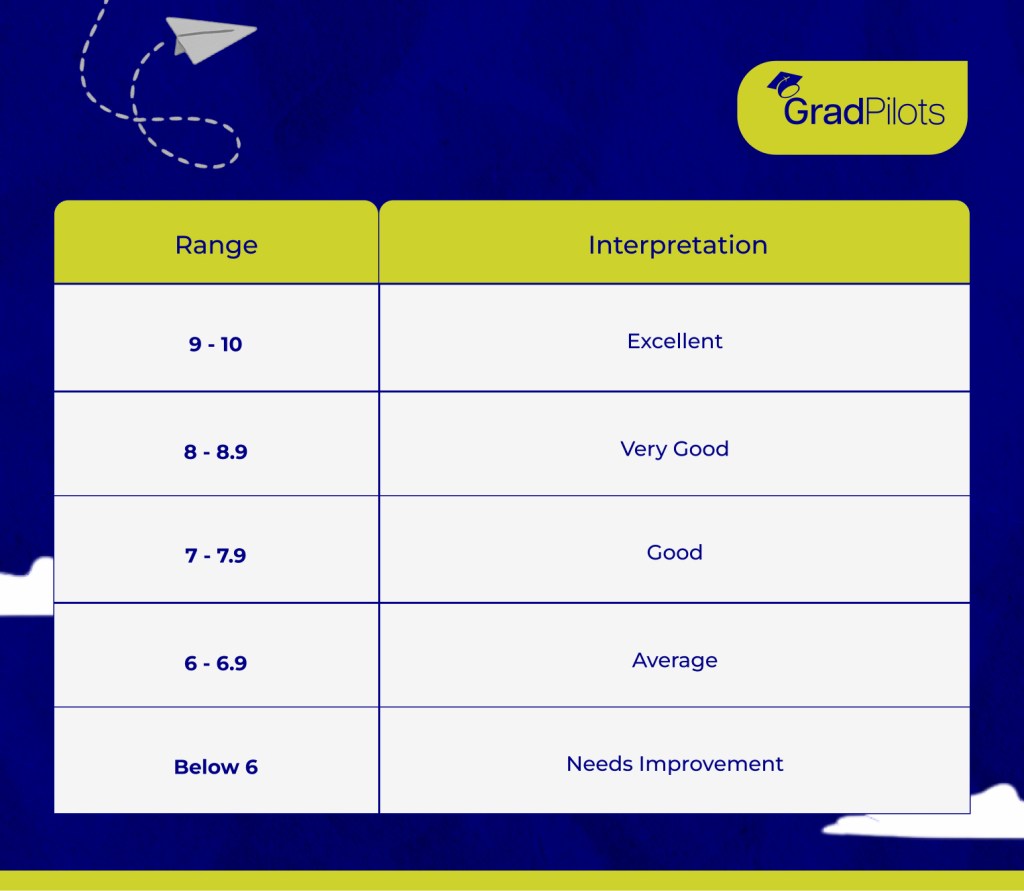
Common CGPA Ranges and Their Meanings
What Is a Good CGPA for College Admissions?
India vs Abroad
In India, a CGPA of 7.5+ is often considered competitive for reputable institutions. For study abroad:
Canada, Europe, Australia: Similar expectations of 3.0+ GPA equivalents.
USA: Minimum GPA equivalent around 3.0 to 3.5 (CGPA ~7.0 to 8.0).
UK: Offers vary; usually a 2:1 classification (around CGPA 7.0+).
Ideal CGPA for competitive programs
Highly competitive programs (Ivy League, top UK universities) generally expect CGPAs equivalent to 3.7+ GPA or above.
Importance of CGPA
CGPA is not just a number but a key indicator for scholarships, internships, and job eligibility. It signals academic consistency and intellectual discipline, which educational institutions and employers value highly.
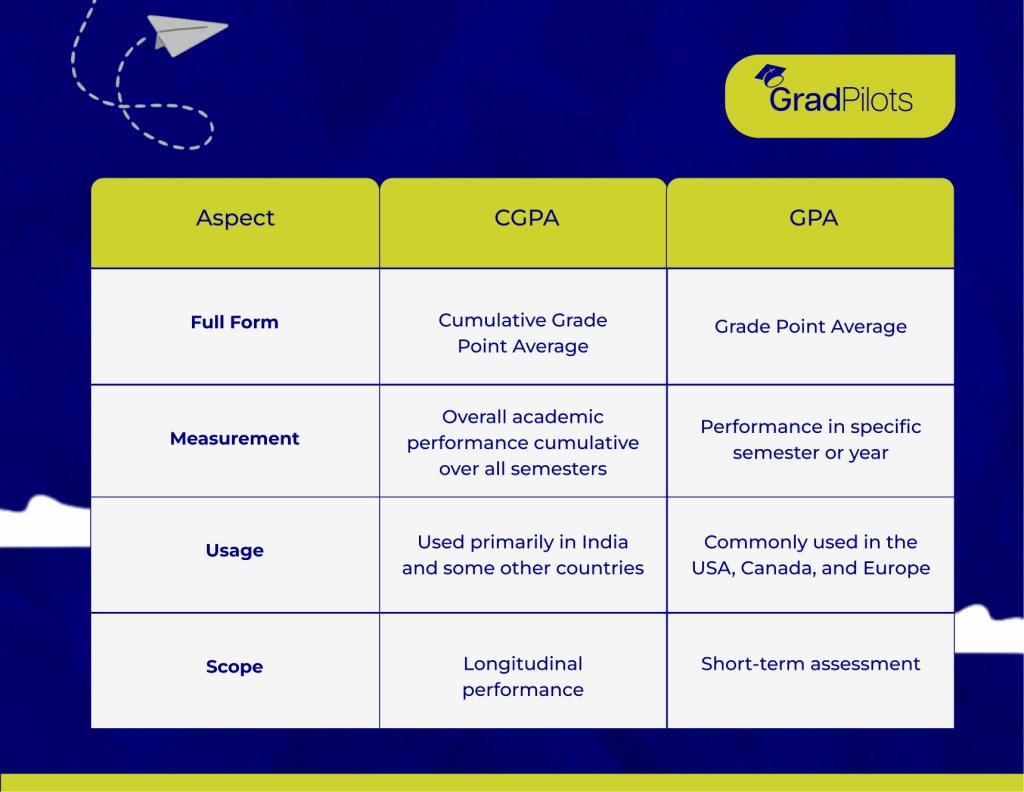
CGPA vs GPA: Key Differences
CGPA vs CGPI – Is it different?
CGPA and CGPI (Cumulative Grade Point Index) are terms often used interchangeably, but CGPI sometimes refers to a more precise weighted index considering credit hours.
CGPA vs SPGA – Understand the difference
SPGA (Semester Performance Grade Average) measures academic performance in a single semester, whereas CGPA covers the cumulative performance throughout the program.
Merits and Demerits of CGPA
Merits
- Encourages consistent academic effort.
- Simplifies evaluation over multiple subjects/semesters.
- Facilitates comparison for admissions and scholarships globally.
Demerits
Conversion to percentage or GPA can sometimes be imprecise.
May mask individual subject weaknesses.
Variations in grading policies between institutions reduce universal applicability.
Final Thoughts
To understand CGPA is to recognise that it sits at the intersection of precision and perspective. It reflects the work you have put in, the discipline you have built, and the way you continue to grow. It is both a mirror of your commitment and a map that shows the doors your effort can open, whether in education or in your future career.
But CGPA comes with layers. Different scales, conversion systems, and institutional expectations create a landscape that takes intention to navigate. These numbers are never just numbers. They influence scholarships, admissions, and professional opportunities. They push us to look beyond single moments and focus on the full arc of our learning.
Choosing to build a strong CGPA is not only an academic choice. It is a personal one. It is a quiet declaration of your discipline, your hunger for knowledge, and your willingness to rise. Aristotle said that the aim of art is to reveal the inward meaning of things, not just their outward appearance. Your CGPA carries that same inward meaning. It holds your journey, the challenges you overcame, the victories you earned, and the possibilities that are waiting for you.
As you work with your CGPA, remember the influence it has on your story. Let it guide you toward excellence that comes from sincerity and intention, not from chasing a number but from honouring who you are and the future you are building.
At GradPilots, we invite you to take the first step towards your future. One step towards the right direction.
Frequently Asked Questions (FAQs)
CGPA stands for Cumulative Grade Point Average. It represents a student’s overall academic performance across all semesters of a program.
CGPA is calculated by averaging the grade points obtained in all semesters.
Formula:
CGPA = (Sum of SGPA of all semesters) ÷ (Number of semesters)
In some universities, grades are weighted based on course credits.
Yes, they differ in scope.
SGPA (Semester Grade Point Average): Performance in one semester
CGPA (Cumulative Grade Point Average): Performance across all semesters
GPA (Grade Point Average): Commonly used internationally, especially in the US, usually on a 4-point scale.
Yes, but it is not the only factor. Used as an initial screening criterion. Important for campus placements and entry-level roles
Skills, internships, projects, leadership, and communication matter more after screening.
Yes, it is possible. Universities consider the overall profile, including Standardised test scores, Work experience and internships, Research and academic projects, Statement of Purpose, and Letters of Recommendation. A strong profile can compensate for a lower CGPA.
Strengthen fundamentals in weak subjects
Plan coursework strategically
Focus on credit-heavy subjects
Maintain consistent study habits
Use academic support and faculty office hours
Avoid last-minute preparation
Yes. An 8.0 CGPA is generally considered competitive. It meets the requirements for many universities.
Strong test scores, experience, and SOP improve chances. Viable for MS programs in both the USA and Canada