IELTS vs TOEFL: Which Test is better?


Language is more than words. It is the bridge between who we are and the opportunities we reach for. For millions of students and professionals across the globe, IELTS and TOEFL are not just exams. They are gateways to new lives, new cities, new universities, and new beginnings.
Choosing the right test is not a decision you make casually. It can shape whether you study in the UK or the US, whether you qualify for scholarships, or even whether your immigration process moves forward smoothly.
In this piece, I want to explore the difference between IELTS and TOEFL with honesty and depth. This is not just about exam formats or scores. It is about your story and how you align with the right path forward. As the philosopher Ludwig Wittgenstein once wrote, “The limits of my language mean the limits of my world.” These exams are the keys that expand those limits.
Understanding the Key Differences between IELTS and TOEFL
What Are IELTS and TOEFL?
- IELTS (International English Language Testing System) is widely accepted in the UK, Europe, Australia, Canada, and increasingly in the US.
- TOEFL (Test of English as a Foreign Language) is particularly favoured in the United States but is also globally recognised.
- Both are designed to test proficiency in reading, writing, listening, and speaking.
- Both are accepted for immigration, higher education, and career pathways worldwide.
Test Formats and Sections
- IELTS
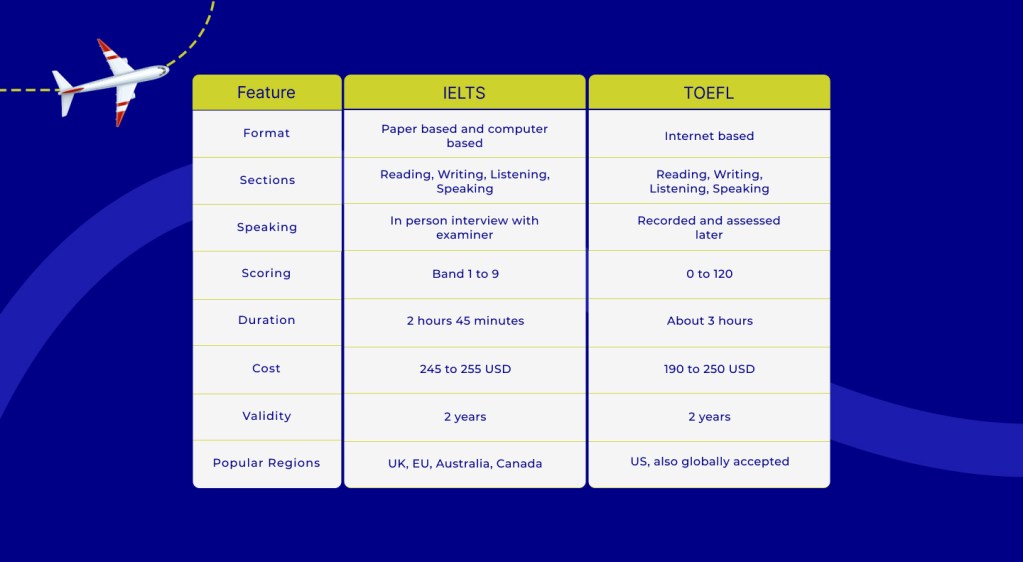
- Two formats: paper-based and computer-based
- Sections: Reading, Writing, Listening, Speaking
- Speaking is a live interview with an examiner
- TOEFL
- Primarily internet-based (TOEFL iBT)
- Sections: Reading, Writing, Listening, Speaking
- Speaking is recorded and assessed later
Scoring System
- IELTS
- Band scale from 1 to 9
- Each section scored individually and averaged
- Common university requirements: 6.5 to 7.5 overall
- TOEFL
- Total score out of 120
- Each section contributes up to 30 points
- Common university requirements: 90 to 105
Global Acceptance and Preferences
- United States: TOEFL is more commonly requested, though IELTS is also accepted
- United Kingdom and Europe: IELTS dominates
- Canada and Australia: IELTS is widely preferred
- Scholarships and Visas: Both are valid depending on the destination country.
Cost
- IELTS: Around 245 USD to 255 USD, depending on the country
- TOEFL: Around 190 USD to 250 USD, depending on the region
What are the Most Commonly Used English Language Proficiency Tests in the US?
In the United States, the TOEFL has long been the most common choice. However, IELTS is now equally recognised by most universities. Other tests like Duolingo English Test are emerging, but IELTS and TOEFL remain the gold standard.
Which Test is Better for You?
The truth is, there is no one size fits all. The decision rests on three things:
- Destination Country: If you are aiming for the UK, Australia, or Canada, IELTS might serve you better. For the US, TOEFL is often favoured, though IELTS is accepted.
- Academic Needs: Some programs or scholarships explicitly mention one exam. Always check requirements.
- Personal Strengths: Do you prefer speaking to a person or recording your voice? Do you perform better in longer or shorter tests?
Pros of IELTS
- Shorter duration
- Speaking with a real examiner may feel more natural
- Accepted widely for immigration purposes
Cons of IELTS
- Face-to-face speaking can be intimidating
- Scoring is band-based, which some find less precise
Pros of TOEFL
- Structured and entirely computer-based
- Scoring out of 120 allows for a more detailed evaluation
- Preferred in the US
Cons of TOEFL
- Longer test duration
- Speaking into a computer may feel less personal
As Aristotle once said, “Knowing yourself is the beginning of all wisdom.” The better you understand your strengths, the clearer this choice becomes.
Preparation Tips and Resources
- Start early: give yourself at least 3 to 6 months
- Take diagnostic tests to find weaknesses
- Focus on academic reading and listening for TOEFL, everyday communication for IELTS
- Practice speaking out loud regularly
- Use official test prep resources and full-length practice exams
- Combine online training with offline feedback if possible
Conclusion
IELTS vs TOEFL is not about which exam is superior. It is about which aligns with your goals, your country of choice, and your natural strengths. Both are respected, both can open doors, and both test not only your knowledge of English but also your ability to adapt and present yourself confidently.
At the end of the day, these tests are stepping stones. They are not the measure of your intelligence or your potential. They are simply tools to help you take that next leap.
And if you need guidance on this journey, GradPilots is here to walk with you.
Frequently Asked Questions
IELTS is often seen as easier for non-US students since its style is closer to everyday English.
Not harder, but more academic and structured.
Yes, conversion charts are available.
Both are globally accepted, though TOEFL dominates in the US and IELTS in the UK, Canada, and Australia.
Roughly 102 to 109 in TOEFL.
TOEFL can sometimes be cheaper depending on the region.
IELTS and TOEFL scores are valid for two years.
Usually, no, but you can submit whichever is accepted.
TOEFL, though IELTS is now widely accepted.
Look at your destination country, program requirements, and your personal strengths.