
How to Get Scholarships to Study Abroad: A Step-by-Step Guide


Studying abroad isn’t just a dream anymore—it’s a goal within reach for many, thanks to scholarships that ease the financial burden. Whether you’re planning to study marine biology in Australia, engineering in Germany, or art history in Italy, there’s a scholarship out there waiting for you. But how do you find it, win it, and actually make it count? Let’s break it down—no fluff, no fuss, and definitely no boring advice.
First things first: scholarships aren’t one-size-fits-all. There are merit-based scholarships for those with top grades or test scores, need-based ones for students from modest financial backgrounds, destination-specific scholarships from countries like Japan, Canada, or the UK, and even quirky ones like the “Vegetarian Resource Group Scholarship.” Yes, really.
Now, here’s a simple stat to get you motivated: in 2023, over 60% of international students in the U.S. received some form of financial aid—scholarships, grants, or work-study. Yet, a huge number of applicants skip applying because they think they won’t qualify. Spoiler alert: most of them were wrong.
So, how do you not waste your time? Start by narrowing your search. Websites like GoAbroad, FastWeb, and Scholarships.com have powerful filters. Looking for a need-based scholarship to study in the UK for your Master’s in Data Science? Filter it. Want a scholarship that doesn’t require an essay? Yep, you can filter that too.
When applying, don’t fall into the “copy-paste trap.” Scholarship reviewers can smell generic answers from a mile away. Instead, customize your applications. Say you’re applying for the DAAD Scholarship in Germany. Don’t just write “I want to study in Germany because it’s a great country.” Try this instead: “Germany’s cutting-edge renewable energy research directly aligns with my goal to combat climate change in my home country, India.” That’s personal. That’s memorable.
Here are some cool scholarships you can check out:
Step-by-Step Guide to Getting a Scholarship
Step 1: Know What You Want
Before you even start applying, be clear on your destination, course, and intake. Aarav from Mumbai wanted to pursue an M.S. in Robotics in Germany, so he focused entirely on Germany-based scholarships like DAAD. This gave his application a sharp focus and saved him hours of research.
Step 2: Search Smartly
Use trusted platforms like GoAbroad, ScholarshipPortal, and official university websites. Customise your search by country, degree, field, and eligibility. Priya, an aspiring art historian from Kolkata, filtered for Italy-based art scholarships and found a partial tuition waiver from Politecnico di Milano.
Step 3: Organise Your Documents
Create a folder with your essentials: Statement of Purpose (SOP), Letters of Recommendation, academic transcripts, proof of income, and resume. This “scholarship toolkit” saves time when applying to multiple scholarships and helps you stay organised.
Step 4: Customise Every Application
Avoid copying and pasting the same SOP everywhere. Make each one personal and relevant. Jamal from Nairobi won an environmental science grant by sharing how his village’s water crisis inspired his passion for sustainability—exactly the kind of personal connection funders look for.
Step 5: Apply Early, Apply Often
Start at least 8–12 months before your program. Rhea, who applied to 12 different scholarships for her degree in the Netherlands, was rejected by 9—but the 3 she got covered her full tuition and accommodation.
Why are Scholarships Crucial for Studying Abroad?
Scholarships aren’t just financial help—they’re golden tickets. They make studying abroad possible for students who deserve it, not just those who can afford it.Let’s face it—studying abroad is expensive. According to UNESCO, the average international student spends $20,000–$45,000 per year on tuition and living expenses. That’s enough to scare anyone off. But scholarships change the game.
Here’s what scholarships really do:

And the numbers prove it—61% of students with scholarships graduate on time versus just 44% without financial aid. Plus, funded students are twice as likely to study in top-tier institutions, according to a GoAbroad survey.
Scholarships don’t just pay the bills. They buy freedom, focus, and future potential. They’re not backup plans—they’re launchpads.
Types of scholarships
Need-Based Scholarships
These are awarded to students who demonstrate financial need. If tuition fees and living costs are a genuine barrier, this is your category. Many government and university programs offer these to promote education access regardless of background.
Example: The Fulbright Program considers both academic excellence and financial circumstances for funding.
Merit-Based Scholarships
These are all about performance—grades, test scores, leadership roles, or extracurricular excellence. If you’ve got a strong academic record or special talent (in sports, music, etc.), this is your shot.
Example: The Rhodes Scholarship is one of the most prestigious merit-based scholarships in the world.
Government Scholarships
Offered by national governments to attract global talent or support foreign relations, these scholarships often cover full tuition, travel, and living expenses.
Example: The Chevening Scholarship by the UK government covers full costs for future global leaders.
Private Scholarships
Funded by corporations, NGOs, or foundations, these can be very specific—targeting fields like AI, climate science, or even certain demographics.
Example: The Inlaks Shivdasani Foundation Scholarship supports Indian students studying at top global universities in niche subjects.
University-Funded Scholarships
Many universities have their own scholarship funds for international students. These range from partial fee waivers to full-ride scholarships.
Example: ETH Zurich offers Excellence Scholarships to outstanding international Master’s students.
Scholarships by Level of Study
Not all scholarships are created equal—what you’re eligible for often depends on your level of study. Whether you’re fresh out of high school or applying for a Master’s or Ph.D., the funding landscape can vary a lot.
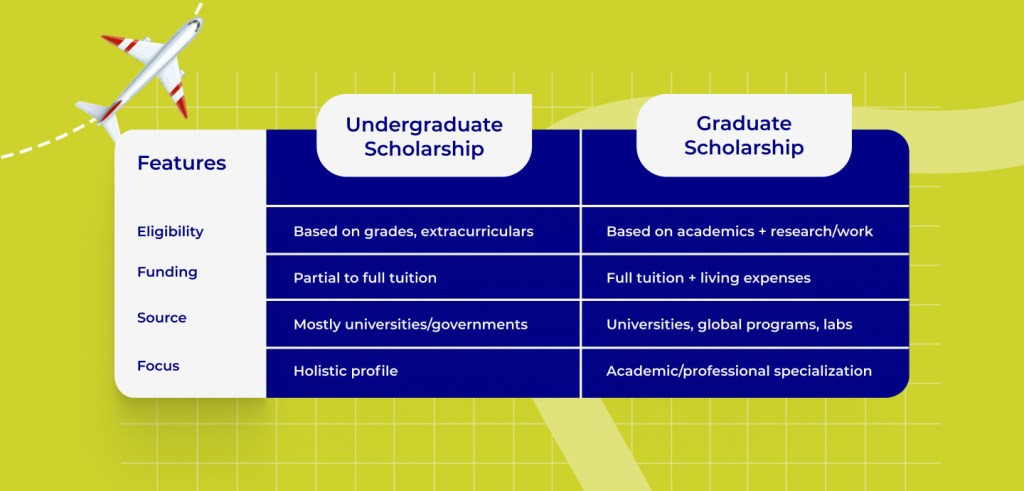
Undergraduate Scholarships vs. Graduate Scholarships
Undergraduate Scholarships are typically awarded based on academic merit, financial need, or a mix of both. These are offered by universities, private foundations, and government programs to support students pursuing their first degree abroad. They usually focus on holistic profiles—grades, extracurriculars, volunteer work, and leadership roles.
Example: The Lester B. Pearson International Scholarship at the University of Toronto covers tuition, books, and residence for outstanding high school students.
Graduate Scholarships (for Master’s or Ph.D. programs) tend to be more specialised and competitive. They often include research components, assistantship roles, or require work experience. These scholarships can fully fund your studies and may even include stipends for living expenses.
Example: Erasmus Mundus Joint Master’s Degrees offer full funding to international students, including tuition, travel, and monthly allowances.
Key Differences at a Glance:

Common Mistakes to Avoid When Applying for Scholarships
Many Indian students miss out on scholarships not because they’re unqualified—but because of simple, avoidable mistakes. Here’s a quick list to help you stay ahead:
1. Starting Too Late
Deadlines for major scholarships are often 8–12 months before the intake. Waiting for admission results first = missed opportunity.
2. Using the Same SOP Everywhere
A generic Statement of Purpose won’t cut it. Each scholarship has different goals—your SOP should reflect that.
3. Ignoring Small or Partial Scholarships
Many students only go for big-name, fully funded ones. But smaller awards can add up and make a real difference.
4. Skipping Country-Specific or Subject-Specific Awards
There are scholarships just for Indian students in fields like STEM, public health, or development studies—most go unnoticed.
5. Not Highlighting Extracurriculars or Leadership Roles
Indian students often focus only on marks. But global scholarships value holistic profiles—volunteering, internships, or passion projects matter.
6. Weak Documentation
Incorrect transcripts, missing LORs, or sloppy resumes can ruin an otherwise strong application. Double-check everything.
7. Underestimating English Proficiency Scores
Low TOEFL/IELTS scores—even if you’re a good speaker—can disqualify you. Prep properly and aim high.
Avoiding these mistakes can instantly boost your chances and ensure you’re actually tapping into the full range of scholarships available.
Conclusion
Getting a scholarship to study abroad isn’t just about funding—it’s about unlocking the full potential of your future. From tuition relief to international exposure and career acceleration, scholarships offer far more than just financial aid. But finding the right one, applying strategically, and presenting yourself well can be overwhelming—especially for Indian students unfamiliar with the global education system.
That’s where GradPilots comes in. We don’t just list scholarships—we guide you through them. Whether you’re a high school student eyeing your dream undergrad course or a working professional aiming for a Master’s abroad, GradPilots offers a complete end-to-end solution:
- Personalised Scholarship Discovery: We help you find scholarships that match your
academic profile, financial needs, and target countries. - Profile Building Support: From SOP drafting to resume refinement and LOR strategy, our experts help shape a standout application tailored to each scholarship and university. We also offer a psychometric test that evaluates your strengths, interests, and personality traits—helping you choose the right major, course, and even country. This ensures you’re not just applying to top universities, but to ones that are truly the right fit for your academic and career goals.
- Application Planning: We track deadlines, recommend timelines, and guide you through each step—no last-minute chaos.
- Pre-Departure to On-Campus Success: Once you’re admitted, we assist with accommodation, budgeting, and settling in—so you’re not navigating everything alone. Plus, through our GradPilots Peer Network, you get connected with students and alumni who are already studying at your dream college. They share real-life insights, help you avoid common mistakes, and guide you through campus life, academic expectations, and cultural adjustments. Whether it’s finding the best dorms, understanding class formats, or just knowing where to buy groceries—your peers have your back.
- Career & Academic Excellence: At GradPilots, you don’t just get into a great college—you thrive there. Our network of mentors and peers already studying at top universities offers real-time guidance on academics, career choices, and campus life. With their support, success abroad isn’t just possible—it’s personal.
Ready to Launch Your Global Education Journey?
Let GradPilots guide you to the perfect course, country, and university.
We’re not just here to get you in. We’re here to help you excel.
Frequently Asked Questions
Countries like Germany, Norway, and Sweden often offer full scholarships or tuition-free education, especially for postgraduate students. Programs like DAAD (Germany) and Erasmus+ (EU) cover tuition, living, and travel costs.
Yes, some universities accept alternatives like Duolingo, TOEFL, or waive tests if your previous education was in English. Countries like Germany, Norway, and the Netherlands offer options without IELTS for select programs.
Absolutely. Scholarships like Chevening (UK), Fulbright (USA), and Erasmus Mundus (EU) are fully funded and cover tuition, travel, and living expenses.
Generally, a minimum GPA of 3.0/4.0 (or 75%+) is expected. However, higher GPAs improve your chances, especially for competitive scholarships.
Germany and Norway offer generous, less competitive public scholarships, especially for STEM and research-based courses. Acceptance often depends on fit rather than just grades.
Start early, research well, build a strong profile (SOP, LORs, resume), and apply smartly. Platforms like GradPilots help match you with scholarships based on your academic and career goals.
The UK, USA, Canada, and Germany top the list for prestigious and high-value scholarships. Their programs support everything from tuition to networking and post-study opportunities.
Yes! In fact, it’s recommended. Many students apply to 5–10 scholarships simultaneously. Just make sure to tailor each application and check for overlapping terms.
USA, UK, Germany, Australia, and Canada offer the highest number of scholarships to Indian students—across undergraduate, graduate, and research programs.
Not always. While some master’s programs (like MBAs) prefer work experience, many undergrad and research scholarships focus purely on academics, leadership, and community impact.
